Test: a practical guide to understanding, using, and evaluating tests
A practical guide to what tests are, how they’re used, and how to choose and interpret them effectively.
There is no single universal “test.” Instead, tests come in many shapes and serve various purposes, from checking what someone knows to measuring a physical condition or evaluating a product’s quality. This guide helps you understand what a test is, how it’s designed, how to interpret results, and how to choose the right test for your needs.
Comparison of test formats by purpose and context
| Format | Typical use | Pros | Cons |
|---|---|---|---|
| Multiple-choice | Broad knowledge checks | Fast scoring | Guessing possible |
| Short answer | Concept understanding | Shows reasoning | Scoring effort |
| Essay | Depth of analysis | Rich feedback | Time consuming |
| performance task | Skill demonstration | Real-world relevance | Setup complexity |
| oral exam | Communication skills | Flexible | Grading subjectivity |
| diagnostic | Identify gaps | Actionable signals | Limited scale |
Compiled November 2026; check the provider's site for current details.
What a test is and isn’t
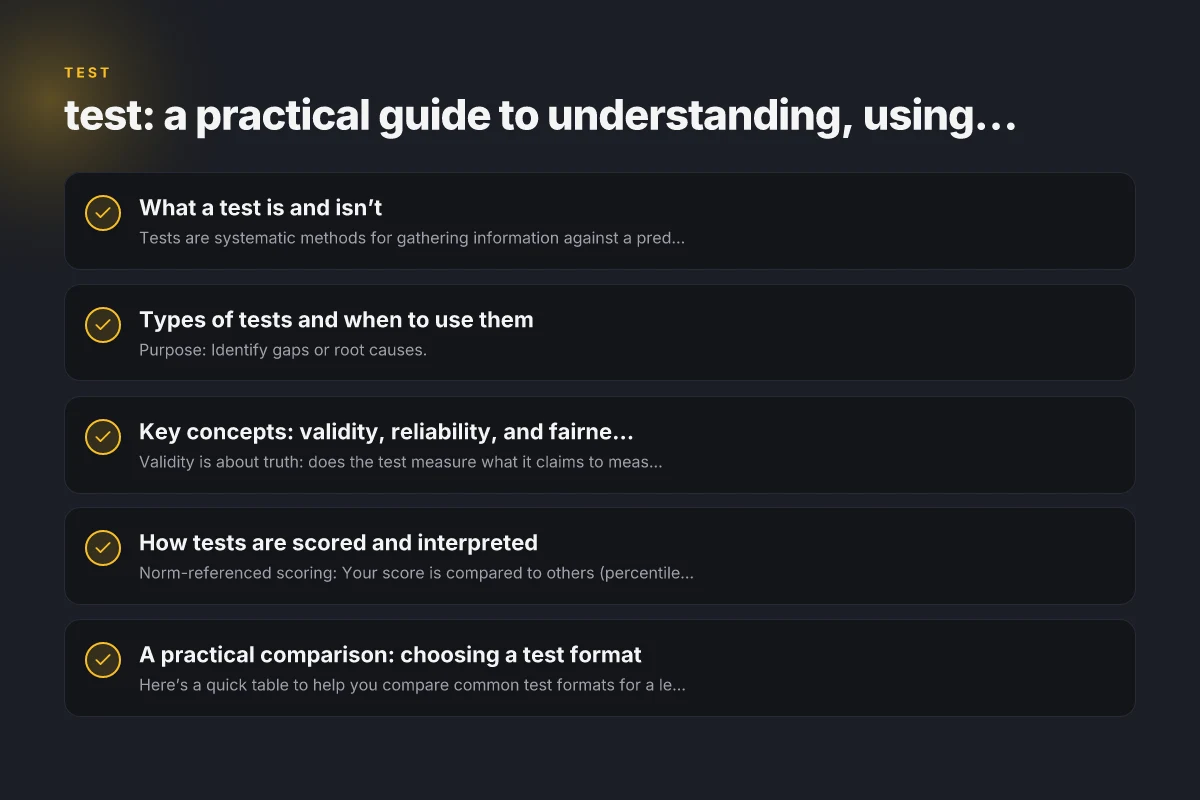
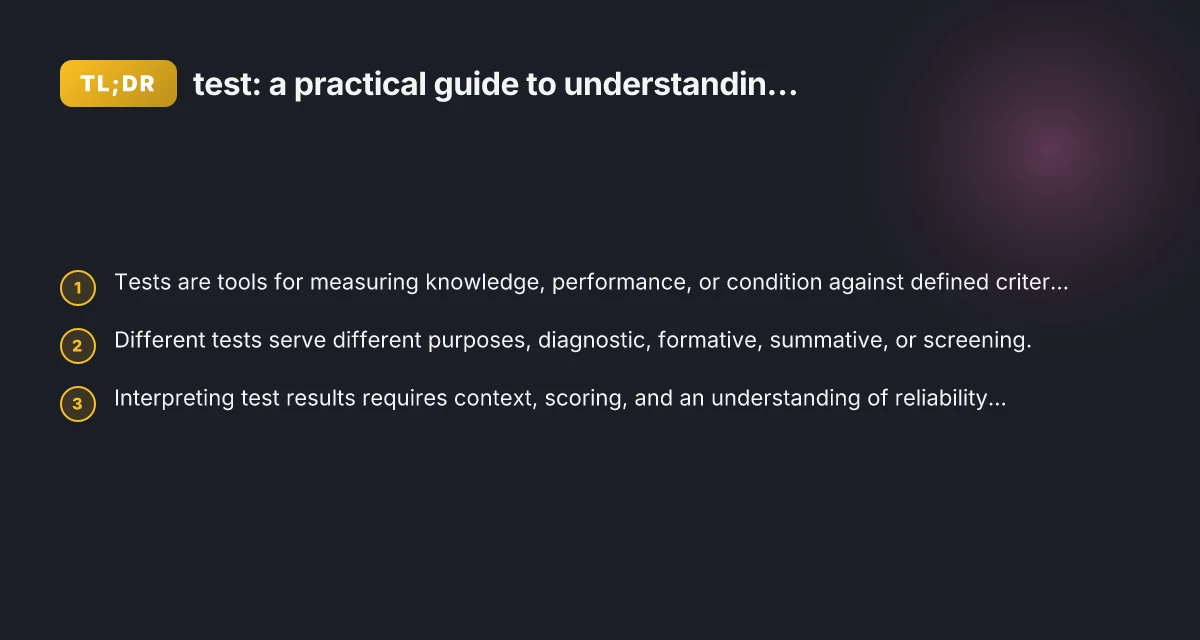
Tests are systematic methods for gathering information against a predefined standard, criterion, or set of expectations. They are not arbitrary questions or a guess about someone’s abilities. A well-designed test has:
- Clear objectives: What knowledge, skill, or condition is being assessed?
- Consistent scoring: A rubric or scoring guide that can be applied reliably.
- Validity: The test actually measures what it intends to measure.
- Reliability: The results are consistent across administrations and scorers.
Common misconceptions:
- A test always tells the whole truth about a person’s ability.
- A single score captures the complexity of a person’s knowledge or health.
- More difficult questions automatically mean a better assessment.
Tests come in many formats, including multiple-choice exams, practical demonstrations, performance tasks, surveys, and standardized measurements. Each format has strengths and weaknesses, depending on what you’re trying to learn.
Types of tests and when to use them
Diagnostic tests
Purpose: Identify gaps or root causes. When to use: At the start of a learning unit or after a concerning symptom or performance drop. What they focus on: Specific skills, misconceptions, or conditions. Example domains: medical diagnosis, learning gaps, software debugging. Study spanish in Mexico group course san cristobal de las casas chiapas Mexico
Formative tests
Purpose: Guide learning and feedback during a process. When to use: Throughout a course or project to monitor progress. What they focus on: Process, effort, and improvement rather than final correctness. Example domains: weekly quizzes, draft reviews, practice labs.
Summative tests
Purpose: Judge overall mastery after a period of instruction or a project. When to use: At the end of a unit, module, or course. What they focus on: Comprehensive knowledge and application. Example domains: final exams, end-of-project evaluations.
Screening tests
Purpose: Flag individuals who may need further evaluation. When to use: Large populations where resources for full assessment are limited. What they focus on: Risk indicators or symptoms. Example domains: healthcare screenings, employment pre-screenings.
Performance and practical tests
Purpose: Assess real-world ability to perform tasks. When to use: Jobs, trades, or any scenario requiring hands-on competence. What they focus on: Demonstrated skill, accuracy, and efficiency. Example domains: driving tests, lab skill checks, cooking competitions. Spanish Test: The Ultimate Guide to Preparing, Taking, and Excelling
Health and fitness tests
Purpose: Measure physical or biochemical status. When to use: Routine checkups, athletic training, or medical monitoring. What they focus on: Vital signs, fitness percentiles, biomarkers. Example domains: VO2 max tests, allergy panels, basic metabolic panels.
Key concepts: validity, reliability, and fairness
Validity
Validity is about truth: does the test measure what it claims to measure? Types include:
- Content validity: Coverage of the domain of interest.
- Construct validity: Theoretical constructs are actually being assessed.
- Criterion validity: Scores correlate with an external standard.
Reliability
Reliability is about consistency: would you get similar results under similar conditions? Types include:
- Test-retest reliability: Stability over time.
- Inter-rater reliability: Agreement between different scorers.
- Internal consistency: How well the items measure the same concept.
Fairness and bias
Fair tests work for diverse groups and do not favor any one group. Consider: Spanish resources links: a comprehensive guide to finding top Spanish learning and cultural resources
- Accessibility: language, disabilities, cultural relevance.
- Item wording: clarity and avoidance of trick questions.
- Context: test environment and timing.
How tests are scored and interpreted
Scoring approaches
- Norm-referenced scoring: Your score is compared to others (percentiles).
- Criterion-referenced scoring: Your score is compared to a fixed standard (proficiency levels).
- Diagnostic scoring: Focused on specific areas of strength or weakness.
Interpreting scores
- Look for a defined cut score or performance standard.
- Consider the score range and what it means in context (course grade, clinical decision, eligibility).
- Beware of over-interpretation: a single score rarely captures a full picture.
Confidence and uncertainty
- Confidence intervals: Some tests estimate the range within which the true value lies.
- Margin of error: Small differences near the cut score can be ambiguous.
- Re-testing: Often reduces uncertainty when appropriate.
A practical comparison: choosing a test format
Here’s a quick table to help you compare common test formats for a learning environment:
| Format | Strengths | Limitations | Best use case |
|---|---|---|---|
| Multiple-choice | Scalable, objective scoring | Guessing can distort true knowledge | Broad knowledge checks, large cohorts |
| Short answer | Assesses recall and understanding | Subjective scoring possible | Conceptual understanding, reasoning |
| Practical performance | Demonstrates real skills | Time-intensive, resource-heavy | Lab work, crafts, hands-on tasks |
| Essay | Deep reasoning, synthesis | Grading complexity and bias risk | Analysis, argumentation, communication |
| Oral presentation | Communication and organization | Consistency across evaluators | Language, presentation, defense of ideas |
| Adaptive testing | Efficiently targets ability level | Requires sophisticated systems | Personalized assessment, diagnostic clarity |
Key concepts comparison across test types
| Concept | Validity | Reliability | Fairness | Usability | Transparency |
|---|---|---|---|---|---|
| Content validity | High (subject alignment) | Moderate | Depends on construction | Easy to implement | Medium clarity |
| Construct validity | Moderate | High with rubric | Needs clear specs | Rubrics help | Medium detail |
| Reliability | Consistent scoring | Yes | Equity needs checks | Moderate | High rubric reliance |
| Fairness for groups | Aim for no bias | Requires review | Yes with diverse samples | User friendly | Medium disclosure |
| Interpretability | Clear with norms | Stable over time | Needs contextualization | High for users | High for stakeholders |
| Scoring complexity | Simple | Moderate | Can obscure bias | Easy for testers | Moderate transparency |
Compiled November 2026; check the provider's site for current details.
How to design a fair and effective test
- Define clear objectives: What should test-takers be able to do?
- Align content with objectives: Ensure questions map to skills or knowledge.
- Choose an appropriate format: Match the task to what’s being assessed.
- Create clear instructions and examples: Reduce ambiguity.
- Pilot the test: Try it with a small group to catch issues.
- Establish scoring rubrics: Use explicit criteria to minimize subjectivity.
- Review for bias: Check wording, scenarios, and contexts for inclusivity.
- Plan for accessibility: Offer accommodations and alternative formats as needed.
- Provide feedback: Help test-takers learn from results, not just grade them.
Interpreting results in different contexts
- Education: Use results to guide instruction and support. Combine test results with other evidence like participation, assignments, and projects.
- Employment: Use tests as one data point among interviews, experience, and demonstrations. Look for reliability and validity evidence for the role.
- Health: Interpret findings with medical guidelines, patient history, and follow-up tests. A single biomarker rarely tells the full story.
- Research: Emphasize sampling methods, test validity, and the statistical interpretation of outcomes.
Decision guide to choose a test format Spanish immersion programs sancristobal
| Scenario | Recommended format | Why | Key trade-off | When to avoid |
|---|---|---|---|---|
| Quick screening in large class | Multiple-choice | Quick, scalable | Guessing risk | When deep understanding is needed |
| Assess reasoning and explanation | Short answer or essay | Shows thinking | Scoring effort | When fast results needed |
| Skill demonstration in field | Performance task | Realistic | Setup time | When criteria unclear |
| Language fluency check | Oral exam | Spoken skills visible | Scheduling | When written evidence suffices |
| High-stakes decision | Mixed methods | Robust evidence | Time/resource intensive | When constraints are severe |
Compiled November 2026; check the provider's site for current details.
The role of technology and modern testing
Digital platforms enable large-scale assessments, adaptive testing, instant feedback, and richer reporting. Benefits include:
- Personalization: Tailored item difficulty based on prior responses.
- Speed: Quick scoring and immediate insights.
- Accessibility: Digital accommodations, multimedia items, and remote testing.
However, they also bring challenges:
- Security and integrity: Cheating prevention and test security.
- Technical barriers: Access to devices and stable internet.
- Data privacy: Handling of sensitive information and results.
When using technology-based tests, prioritize secure platforms, transparent privacy policies, and user-friendly interfaces. Spanish immersion excursions: immersive ways to learn and explore
When in doubt: how to choose the right test
- Clarify your objective: What decision will the test inform?
- Determine the required evidence: Do you need a broad screen or a precise diagnostic?
- Check validity and reliability evidence: Look for how well the test measures what it claims and how consistently it does so.
- Consider practicality: Time, cost, and resources available.
- Plan for interpretation: How will results drive action or further assessment?
- Seek expert guidance: When available, consult teachers, clinicians, HR professionals, or test developers.
Final recommendations
- Start with a concrete goal: Define what success looks like before selecting or designing a test.
- Use a mix of evidence: Combine test results with performance, feedback, and observational data to form a complete picture.
- Prioritize fairness: Ensure accessibility and fairness for diverse users or participants.
- Be mindful of limitations: Acknowledge the scope and boundaries of what a test can tell you.
- Reassess over time: Tests can be revised as standards change or new evidence emerges.
If you’re implementing tests in a school, workplace, or clinic, remember that tests are tools, not verdicts. They help you measure, compare, and improve, but only when chosen, designed, and interpreted thoughtfully. If you’d like, tell me your specific context (education, hiring, health, or research), and I can tailor a concrete testing plan with example items, scoring rubrics, and an interpretation framework.