Spanish Test: The Ultimate Guide to Preparing, Taking, and Excelling
A practical, comprehensive guide to understanding, preparing for, and succeeding in Spanish tests.
Spanish test preparation can feel daunting, but with a structured approach you can demystify the process and boost your results. This guide walks you through what a Spanish test typically covers, how to prepare effectively, and how to approach test day with confidence. Whether you’re preparing for a school exam, a language certification, or a job-related assessment, the same core strategies apply.
Study plan frameworks
| Framework | Duration per week | Key components | Ideal for | Pros | Cons |
|---|---|---|---|---|---|
| SMART goals | 3–5 hours | Specific, Measurable, Achievable, Relevant, Time-bound | Short-term goals | Clear targets | May feel rigid |
| 90-day plan | 6–10 hours | Milestones, weekly reviews | Long-term mastery | Builds consistency | Requires discipline |
| Time-blocking | 5–8 hours | Fixed blocks, buffer time | Busy schedules | Improves focus | Can be flexible to miss |
| Spaced repetition | 4–7 hours | Flashcards, intervals | Vocabulary and grammar | Retention boost | Setup effort |
Compiled November 2026; check the provider's site for current details.
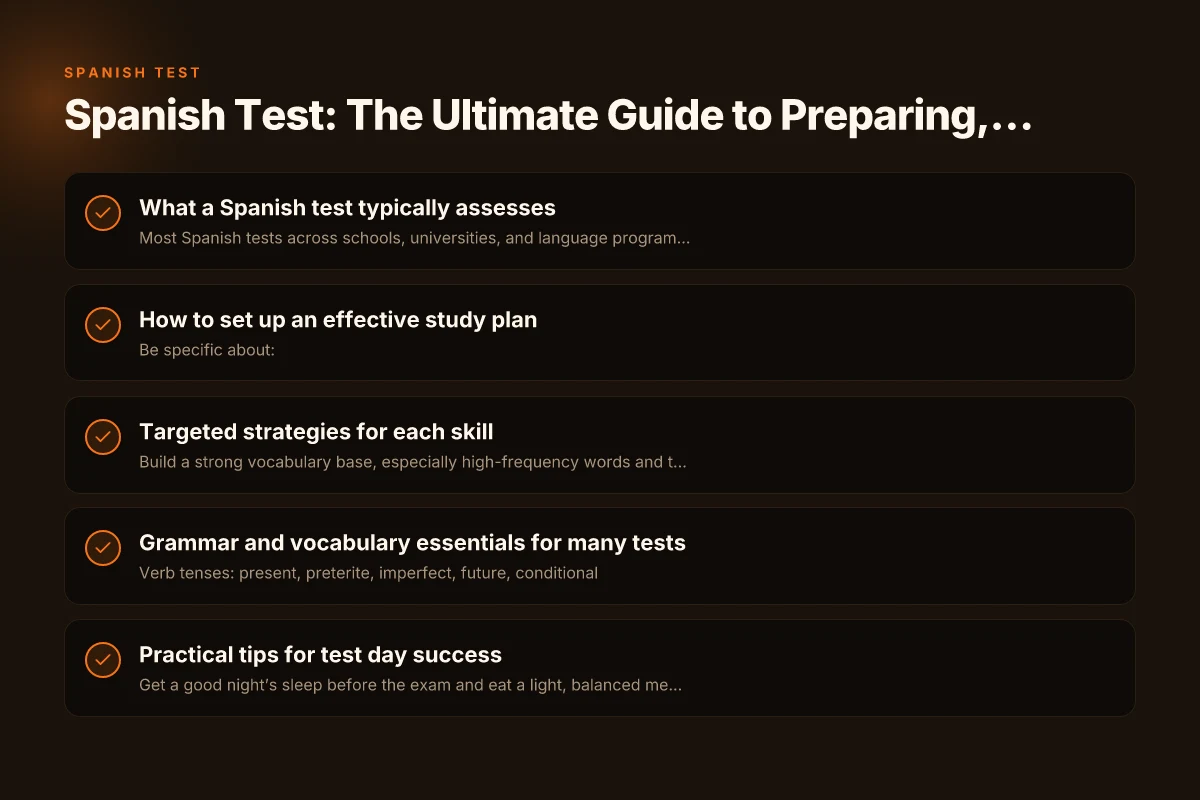
What a Spanish test typically assesses
Common sections
Most Spanish tests across schools, universities, and language programs include a mix of the four core skills:
- Reading comprehension (lectura)
- Listening comprehension (comprensión auditiva)
- Writing (expresión escrita)
- Speaking (expresión oral)
Some tests also include grammar and vocabulary sections, as well as cultural or practical language usage tasks.
Formats you might encounter
Test formats vary, but you’ll often see:
- Multiple-choice questions (MCQs) for grammar, vocabulary, and reading
- Short answer and longer written responses
- Listening passages with questions
- Speak-aloud prompts or interviews
- Writing prompts, such as essays, emails, or summaries
How to set up an effective study plan
Step 1: define your goal and deadline
Be specific about: Spanish resources links: a comprehensive guide to finding top Spanish learning and cultural resources
- Your target score or level (for example, B1 on the CEFR, or a particular grade)
- The date of the exam
- Any prerequisites or requirements you must meet
Step 2: diagnose your current level
Take a diagnostic test or a past paper to see where you stand. Note:
- Strengths (e.g., reading speed, listening comprehension)
- Weaknesses (e.g., irregular verb conjugations, lack of workplace vocabulary)
Step 3: break it into weekly blocks
Create a schedule that covers:
- Regular practice sessions (3–5 days per week)
- Alternating focus days (e.g., reading and vocabulary on one day, listening and speaking on another)
- Rest and review days to consolidate learning
Step 4: diversify your resources
- Textbooks and workbooks aligned with your test
- Online platforms with level-appropriate drills
- Real-life Spanish media: podcasts, news, and shows
- Language exchange or conversation clubs for speaking practice
Targeted strategies for each skill
Reading comprehension
- Build a strong vocabulary base, especially high-frequency words and topic-specific terms
- Practice skimming for main ideas and scanning for details
- Learn common test tactics, such as eliminating obviously wrong options in MCQs
- Practice with varied genres: articles, emails, ads, instructions
Listening comprehension
- Use authentic audio at your target level, including conversations, lectures, and announcements
- Practice listening for gist first, then for specific details
- Train with varied accents and speeds. Slow down difficult clips and gradually increase speed
- Take notes in the margins or on a separate sheet to capture key details
Writing
- Master essential grammar topics: tenses, agreement, pronouns, and common irregular verbs
- Practice different formats: informal emails, formal letters, summaries, and opinion pieces
- Focus on clarity, coherence, and structure: clear thesis, supporting details, and conclusion
- Build a repertoire of connectors to link ideas smoothly
Speaking
- Practice speaking with a partner or tutor. Record yourself to assess pronunciation and grammar
- Prepare and rehearse common prompts (introductions, preferences, experiences, arguments)
- Use structures that promote fluency: beginning, middle, end. Cause-effect reasoning
- Work on pronunciation, rhythm, and intonation to sound natural
Grammar and vocabulary essentials for many tests
- Verb tenses: present, preterite, imperfect, future, conditional
- Subjunctive mood basics in present and past where required
- Pronouns: direct, indirect, reflexive, and object pronouns in correct order
- Prepositions and articles in common contexts
- Everyday verbs and high-frequency nouns for quick comprehension
Here is a compact table comparing common test focus areas:
| Skill area | Typical task examples | Quick tips |
|---|---|---|
| Reading | MCQs, short answers, comprehension questions | Scan for topic, look for signaling words, pay attention to verbs and tenses |
| Listening | MCQs, note-taking, completion tasks | Listen for gist first, then for key details; note numbers and dates |
| Writing | Emails, essays, summaries | Plan briefly; use topic sentences; vary vocabulary and tenses |
| Speaking | Interview, role-plays, monologue prompts | Practice clear structure; use connectors; time yourself |
| Grammar/vocabulary | Fill-in-the-blanks, error correction | Focus on frequent error patterns; learn collocations |
Skill-targeted practice options Spanish immersion programs sancristobal
| Skill area | Practice type | Typical frequency | Feedback quality | Suitable for | Notes |
|---|---|---|---|---|---|
| Listening | Dictation, podcasts | 3–5 sessions/week | Moderate | All levels | Use transcripts after |
| Reading | Skim/scan, comprehension questions | 4–6 sessions/week | High | Interpreting main ideas | Mix genres |
| Speaking | Pronunciation drills, mock viva | 2–4 sessions/week | High | Conversation ease | Record and self-review |
| Writing | Essay prompts, summaries | 3–5 sessions/week | Moderate | Structure and clarity | Peer feedback helps |
| Grammar | Gap-fill, rule drills | 3–5 sessions/week | Moderate | Accuracy | Focus on common errors |
| Vocabulary | Flashcards, word maps | Daily | High | Range of lexis | Include collocations |
Compiled November 2026; check the provider's site for current details.
Practical tips for test day success
- Get a good night’s sleep before the exam and eat a light, balanced meal.
- Bring the required identification and any permitted materials (e.g., pencils, erasers, etc.).
- Read instructions carefully. Allocate time to each section and avoid lingering on difficult prompts.
- Use process-of-elimination strategies for MCQs and structure your speaking responses clearly.
- If you don’t know an answer, move on and come back later if time allows.
- Review your answers if time permits, checking for grammar, spelling, and coherence.
Mock exams and practice tests: why they matter
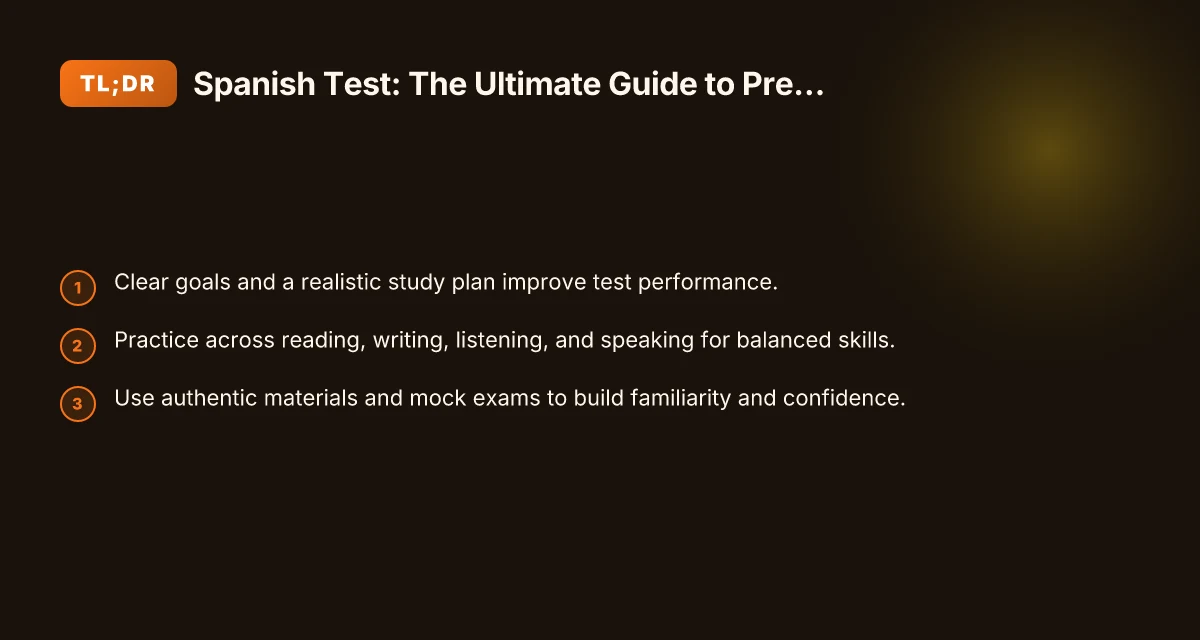
- Realistic timing: practice tests help you manage pace and avoid running out of time.
- Familiarity with formats: exposure reduces anxiety and improves performance.
- Feedback loop: review explanations to understand mistakes and prevent repetition.
- Confidence builder: repeated exposure to test conditions reduces stress.
How to simulate exam conditions
- Use a timer and work in one sitting if possible.
- Remove distractions. Keep your testing environment consistent with the actual test.
- Use authentic or similar materials to your target test level.
Tips for test-taking mindset
- Stay calm and breathe deeply if you feel anxious.
- Read each question carefully. Misinterpretation often wastes points.
- Trust your preparation: you’ve built the knowledge and practice to succeed.
- If allowed, flag difficult questions and return to them later with fresh energy.
Test options comparison (popular Spanish tests)
| Test/Option | Format | Typical length | Scoring | Availability | Pros | Cons |
|---|---|---|---|---|---|---|
| A1–A2 level exam | Paper/online | 1–2 hours | Pass/fail | Widely available | Quick placement | Low proficiency range |
| B1–B2 general exam | Paper/online | 2–3 hours | Proficiency level | Broad recognition | Strong for workplace | Moderate cost |
| College placement | Computer-based | 2–3 hours | Scale score | Institutions | Academic alignment | Limited to schools |
| Challenge/optional assessments | Online modules | Varied | Pass/fail or score | Flexible | Targeted skills | Not universally accepted |
| Mock exams package | Online banks | 2–4 hours | Score bands | Accessible | Practice realism | May not reflect real test |
Compiled November 2026; check the provider's site for current details.
Final recommendation
If you’re aiming for solid results on a Spanish test, adopt a balanced practice plan that touches reading, listening, writing, and speaking equally. Use authentic materials to build vocabulary in context, practice with past papers or mock exams to build familiarity, and schedule regular, scalable study sessions. Pair this with targeted grammar work and speaking practice to create a well-rounded skill set. With consistency and deliberate practice, you’ll approach test day with confidence and clarity. Spanish immersion excursions: immersive ways to learn and explore