Spanish resources links: a comprehensive guide to finding top Spanish learning and cultural resources
A practical guide to reliable Spanish resources links for learners, educators, and culture enthusiasts.
Spanish resources links: where to start Learning Spanish effectively means having a steady stream of reliable resources. This guide collects high-quality Spanish resources links across courses, dictionaries, media, culture, forums, and educators. Whether you’re a beginner, an advanced learner, or a teacher, these links will help you structure study plans, practice daily, and explore Spanish-speaking cultures.
Structured courses and tutoring options comparison
| Resource | Level / Focus | Cost (approx) | Best for | Notes |
|---|---|---|---|---|
| Duolingo Plus | Self-paced; gamified | Free / paid tier | Beginners; quick practice | |
| iTalki tutoring | One-on-one; live | Pay per lesson | Conversation practice; tailored | |
| Rosetta Stone | Structured core lessons | Paid subscription | Absolute beginners to intermediate | Immersive approach; not ideal for grammar depth |
| Coursera Spanish courses | University-style courses | Free audit; paid certificates | Academic learners | Certificate option available |
| Babbel | Short lessons; daily practice | Subscription | Grammar and vocabulary | Clear progression; less cultural content |
| Pimsleur | Audio-based | Subscription | Audio learners; speaking | Focus on pronunciation |
| Lingoda | Live classes; flexible schedule | Subscription | Structured curriculum | Schedule dependent; group classes |
| Verbling | Tutor marketplace | Pay per lesson | Speaking with native tutors | Wide tutor selection |
| Busuu | Community-driven | Free + Premium | Practice with prompts | Community reviews; practical exercises |
Compiled November 2026; check the provider's site for current details.
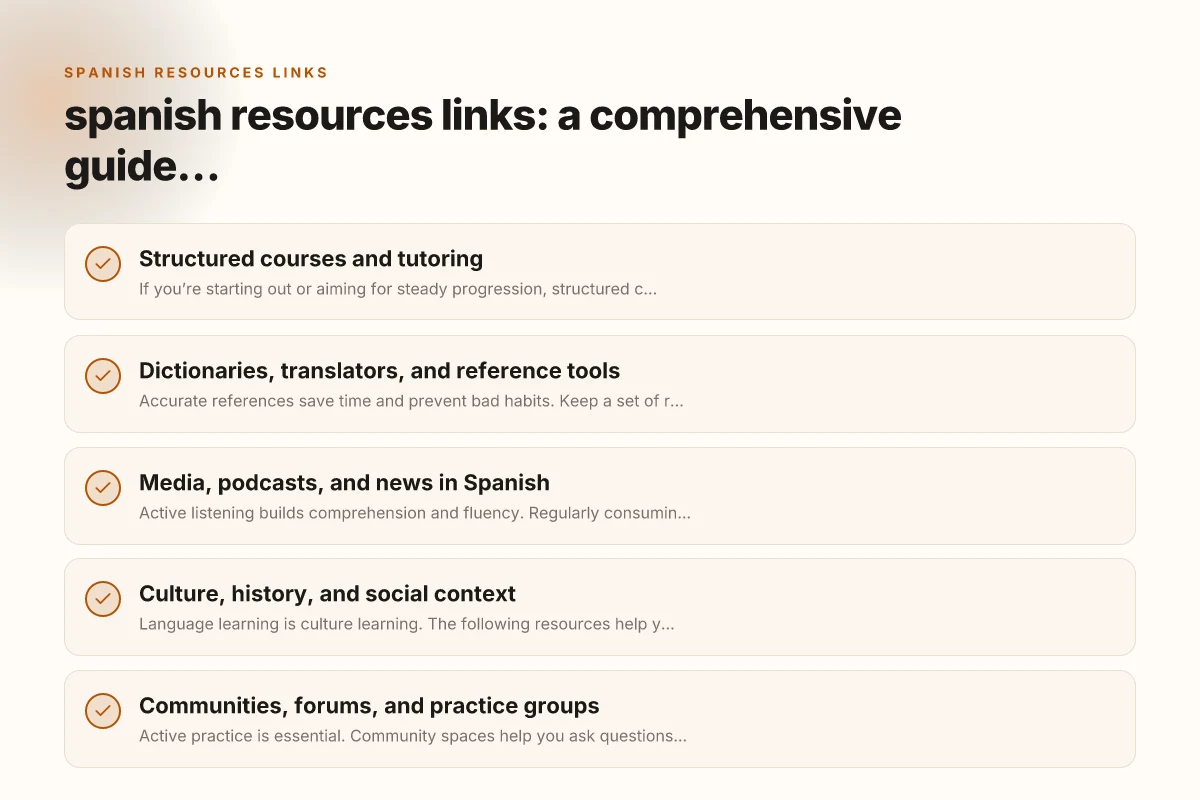
Structured courses and tutoring
If you’re starting out or aiming for steady progression, structured courses provide a clear path and measurable outcomes. Look for courses that offer levelized curricula, exercise sets, and regular assessments.
Free and paid courses worth bookmarking
- Duolingo: a gamified entry point with daily practice.
- Babbel: emphasis on conversation and practical phrases.
- Rosetta Stone: immersive approach with speech recognition.
- Coursera: university-style courses, often with graded assignments.
- edX: access to university courses, sometimes with Spanish language tracks.
- Lingoda: live classes with native teachers (subscription based).
- Busuu: community-driven practice with feedback from native speakers.
Finding a tutor or language coach
- italki: connect with professional teachers and community tutors for one-on-one sessions.
- Preply: searchable tutor marketplace with various price points.
- Verbling: video-based lessons with vetted teachers.
- Local language schools: many cities have culturally oriented centers offering Spanish classes.
Dictionaries, translators, and reference tools
Accurate references save time and prevent bad habits. Keep a set of reliable tools handy for writing and quick checks.
Essential dictionaries and glossaries
- WordReference: widely trusted for Spanish definitions, conjugations, and usage notes.
- Collins Spanish Dictionary: robust bilingual resource with examples.
- RAE (Real Academia Española) online: authoritative grammar and vocabulary guidance.
- Glosbe: multilingual dictionary with community-sourced examples.
- WordSmith: for collocations and frequency data.
Translators and usage aids
- DeepL: high-quality, nuanced translations with contextual tones.
- Google Translate: quick lookups and conversation mode, best for rough ideas.
- Reverso Context: translations with real-world usage in sentence context.
Media, podcasts, and news in Spanish
Active listening builds comprehension and fluency. Regularly consuming authentic content helps you internalize phrases and pronunciation.
News and journalism
- BBC Mundo: clear, accessible Spanish news with multilingual options.
- RTVE: official Spanish broadcaster with diverse programs.
- El País: major Spanish newspaper with in-depth reporting.
- La Vanguardia: contemporary Spanish news coverage.
Podcasts and audio content
- Coffee Break Spanish: structured lessons with natural dialogue.
- News in Slow Spanish: current events presented at slower pace for learners.
- Español automatically from SpanishPod101: varied topics and difficulty levels.
- Radio Ambulante: long-form storytelling from Latin America, great for culture and listening variety.
Films, series, and streaming
- Netflix and Prime Video: look for content with Spanish audio and subtitles.
- YouTube channels: accents from Spain and Latin America vary. Search for language learning channels or channels by Spanish-speaking creators.
- Tito’s Spanish: beginner-friendly videos focusing on everyday language.
Culture, history, and social context
Language learning is culture learning. The following resources help you understand idioms, customs, and history. Spanish immersion programs sancristobal
Cultural hubs and reading lists
- Spanish culture sections of major museums’ sites (e.g., Prado, Reina Sofía) for art history context.
- Latin American literature portals: project Gutenberg Spanish-language classics, contemporary authors’ pages.
- UNESCO sites: information about Spanish-speaking regions’ heritage.
Language and identity topics
- Instituto Cervantes: central hub for Spanish language promotion and study abroad programs.
- AFS or cultural exchange organizations: practical insights into everyday life, etiquette, and education systems in Spanish-speaking countries.
Communities, forums, and practice groups
Active practice is essential. Community spaces help you ask questions, get feedback, and stay motivated.
- Reddit: r/Spanish, r/learnspanish for tips, resources, and language exchange.
- Duolingo forums: user tips and clarifications on course content.
- Tandem and HelloTalk: language exchange apps to practice with native speakers.
- Local conversation clubs: search for “intercambio de idiomas” or “language exchange” in your city.
Dictionaries, translators, and reference tools comparison
| Tool | Type | Offline access | Languages | Strengths | Limitations |
|---|---|---|---|---|---|
| WordReference | Dictionary | Yes | Spanish-English, others | Clear senses; idioms | App interface dated |
| RAE Accents | Reference | Yes | Spanish | authoritative grammar | Narrow scope |
| SpanishDict | Dictionary + translator | Yes | Spanish-English | Quick translations; examples | Translations can be literal |
| Collins Spanish Dictionary | Dictionary | No (online mainly) | English-Spanish | Credible definitions | Premium features limited |
| Google Translate | Translator | Yes (offline packs) | Many languages | Quick gist | Not reliable for nuance |
| Linguee | Dictionary + examples | Yes | Spanish-English | Real usage examples | Indexing varies by term |
| WordReference Conjugator | Conjugation tool | Yes | Spanish | Verb conjugations | Limited phrases |
Compiled November 2026; check the provider's site for current details.
Comprehensive comparison at a glance
Here is a quick side-by-side comparison of popular resource types to help you pick what to explore first. Spanish immersion excursions: immersive ways to learn and explore
| Resource type | Strengths | Best for | Typical cost |
|---|---|---|---|
| Structured courses | Clear progression, assessments | Beginners to intermediate learners | Free to monthly |
| Dictionaries/refs | Quick lookups, grammar notes | Writing, speaking prompts, correctness | Free to premium |
| Media (news/podcasts) | Immersion, real-world language use | Listening skills, cultural context | Free to subscription |
| Culture resources | Context, idioms, history | Deepening understanding of regions | Free to paid |
| Communities | Practice, feedback, motivation | Speaking and writing practice | Free to free tier |
Best practices for using Spanish resources links
- Create a resource map: list 5–8 core sources you use weekly and rotate to keep variety.
- Validate dates and editions: language resources frequently update. Newer editions reflect current usage.
- Balance passive and active learning: combine listening/reading with writing and speaking tasks.
- Set concrete goals: e.g., “average 15 minutes daily listening this week” or “complete 2 grammar exercises each day.”
- Review and reflect: keep a short journal of what you learned and which resources helped most.
Media, podcasts, and news in Spanish comparison
| Source | Type | Availability | Beginner-friendly | Audio quality | Notes |
|---|---|---|---|---|---|
| News in Slow Spanish | News / podcast | Online | Yes | Clear | Slower pace for learners |
| Radio Ambulante | Narrative journalism | Online | Some episodes accessible | Good | Immersive storytelling |
| Duolingo Podcast | Podcast | Online | Yes | Moderate | Spanish with English narration sometimes |
| El País | News | Online | Moderate | Good | Broad topics; fast pace |
| BBC Mundo | News | Online | Moderate | Good | Pan-Spanish coverage; some regional terms |
| Coffee Break Spanish | Podcast | Online | Yes | Clear | Teaches phrases and culture |
| Spotify Spanish podcasts | Various | Yes | Depends | Varies | Wide range of levels |
| RTVE Play | TV/Radio | Online | Moderate | Good | Native content; subtitles optional |
Compiled November 2026; check the provider's site for current details.
Tips for beginners to stay motivated
- Start with a lightweight routine: 10–15 minutes daily is more sustainable than long weekly dives.
- Use a language bank: keep a personal list of phrases you frequently need, like greetings, ordering at a café, or asking for directions.
- Celebrate milestones: finishing a chapter, understanding a news podcast, or holding a 5-minute conversation.
How to build a sustainable Spanish resource list
- Begin with a core course and a reliable dictionary.
- Add a news or podcast source to build listening skills.
- Include a cultural or literature resource for deeper context.
- Join a language exchange group for speaking practice.
- Periodically prune and update your list as your goals shift.
A practical starter bundle
- Core course: Duolingo or Coursera Spanish course (start with beginner level).
- Dictionary: WordReference plus Collins or RAE online for grammar notes.
- Listening: News in Slow Spanish or BBC Mundo.
- Culture: Instituto Cervantes resources and a Spanish-speaking literature primer (short stories or novellas).
- Practice: Italki for weekly tutoring and Tandem for daily language exchange.
Final recommendations If you want a straightforward path, combine a structured course with a reliable dictionary and immersive media. For ongoing learning, mix in news podcasts and a culture-focused resource to keep your motivation high. Always curate your Spanish resources links based on your goals and the time you can commit each week. Regularly revisit and refresh your list to stay aligned with your progress and interests. Spanish immersion christmas course Mexico sancristobal delascasas chiapas
If you’d like, tell me your current level, goals (travel, work, exam prep, conversation), and preferred learning style (video, audio, text), and I can craft a personalized, line-by-line Spanish resources links plan tailored to you.