Mision y vision: aligning purpose and strategy in organizations
A practical guide to understanding and crafting mission and vision statements in English, with examples and tips.
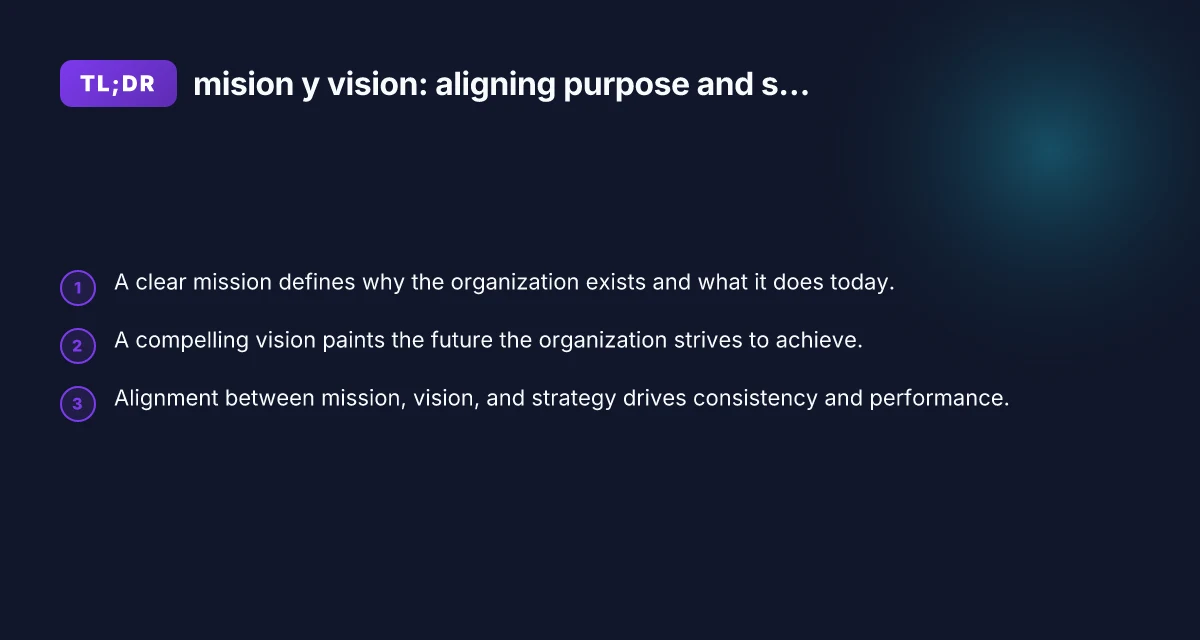
Many organizations struggle to articulate why they exist and where they are headed. The terms “mission” and “vision” are often used interchangeably, but they serve distinct purposes. A strong mission statement explains the present state, the core purpose and value the organization delivers. A strong vision statement describes the future state, the aspirational impact the organization seeks to create. Combined, they guide decision-making, align stakeholders, and set the tone for strategy, culture, and daily operations.
Comparison of mission vs. vision definitions
| Item | What it describes | Time orientation | Primary focus | Examples (short) | Measured by |
|---|---|---|---|---|---|
| Mission statement | Purpose of organization | Present | What we do and for whom | "To serve customers with..." | Stakeholders served |
| Vision statement | Desired future state | Future | Where we aim to be | "To be the leading..." | Long-term impact |
| Core question | Why we exist | Present | Value we provide now | "Why do we exist?" | Clarity of purpose |
| Audience | Internal and external | Present/future | Stakeholder awareness | "For customers, employees, society" | Public understanding |
| Scope | Scope of activities | Present | Boundaries of work | "What we do and don’t do" | Alignment with strategy |
Compiled November 2026; check the provider's site for current details.
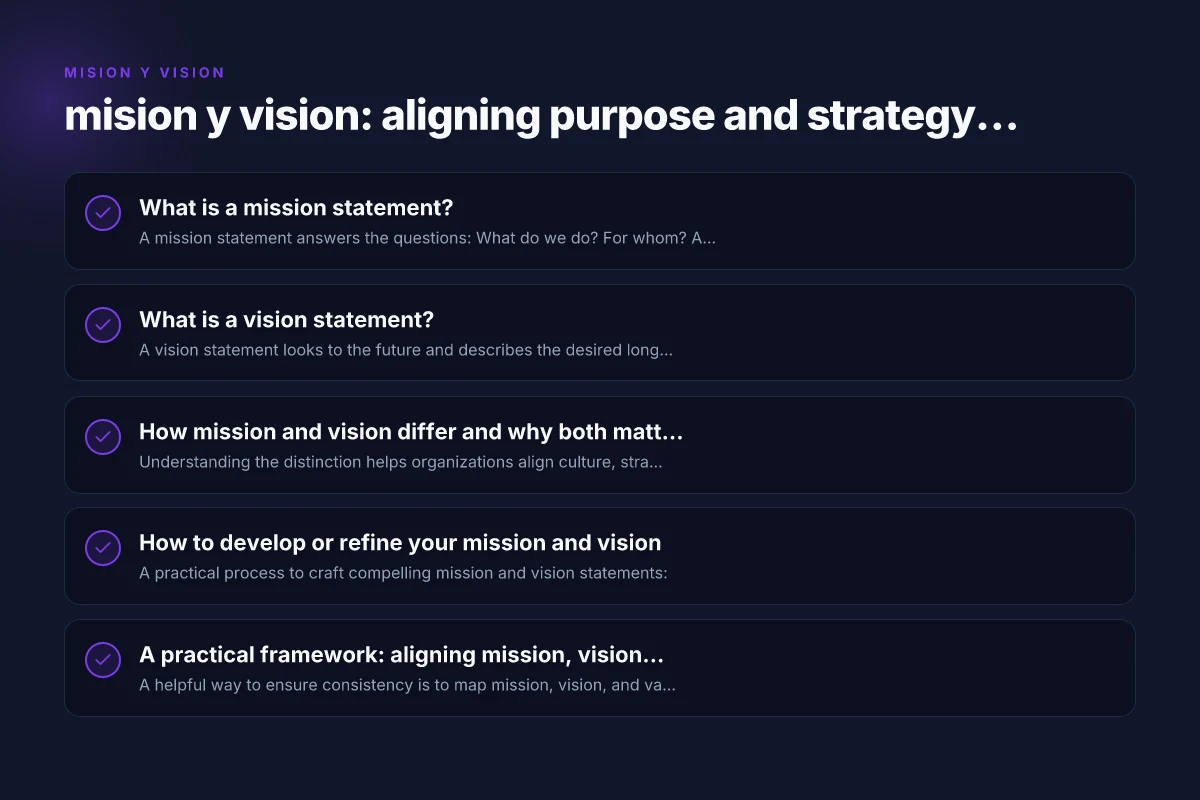
What is a mission statement?
A mission statement answers the questions: What do we do? For whom? And why does it matter? It is grounded in the present and focused on value delivery.
Key characteristics of a good mission:
- Clear and concise: typically one to three sentences.
- Specific about the audience or beneficiaries: who benefits from the organization’s work.
- Action-oriented: often includes verbs that describe daily activities or services.
- Purpose-driven: communicates the impact or outcome the organization aims to achieve.
Examples (paraphrased for readability):
- We provide affordable solar energy solutions to rural communities, improving access to reliable power.
- We help small businesses grow by delivering accessible, high-quality marketing services.
Tips to craft your mission: Lists: A Practical Guide to Using Lists Effectively
- Start with a core purpose statement: “We exist to…”
- Describe the primary audience and the value you deliver.
- Avoid jargon. Use concrete language that anyone inside or outside the organization can understand.
- Include a measurable aspect where appropriate (e.g., reach, impact, or service area).
What is a vision statement?
A vision statement looks to the future and describes the desired long-term outcome or impact. It answers: Where do we want to be? What do we want to achieve in the next 5 to 10 years (or more)?
Key characteristics of a strong vision:
- Aspirational yet credible: ambitious but achievable with effort.
- Inspiring and motivational: creates a sense of purpose and urgency.
- Clear and memorable: often a single sentence or short paragraph.
- Future-oriented: avoids dwelling on current constraints unless necessary for context.
Examples (paraphrased for readability):
- To become a global leader in sustainable energy, transforming how communities power their lives.
- To empower every small business to thrive through accessible, ethical, and innovative marketing.
Tips to craft your vision: Italien: A Practical Guide to the Italian Language, Culture, and Identity
- Imagine the ideal impact in a future where your mission is fully realized.
- Use vivid, concrete language that paints a mental image.
- Tie the vision to values and strategic themes to ensure alignment with actions today.
- Keep it short enough to be memorable, but substantial enough to guide decisions.
How mission and vision differ and why both matter
Understanding the distinction helps organizations align culture, strategy, and performance.
- Time orientation:
- Mission: present-oriented.
- Vision: future-oriented.
- Focus:
- Mission: what you do, for whom, and why it matters.
- Vision: what you aspire to become or accomplish.
- Purpose in decision making:
- Mission guides day-to-day operations and priorities.
- Vision guides long-term strategy and resource allocation.
Why together they matter:
- Alignment: When people understand the mission and buy into the vision, decisions across levels tend to align.
- Communication: Clear statements communicate purpose to employees, customers, partners, and investors.
- Motivation: A compelling mission and an inspiring vision can energize teams and attract talent.
How mission, vision, and values align with strategy options
| Option | Mission alignment | Vision alignment | Values alignment | Governance implication | Practical signals |
|---|---|---|---|---|---|
| Option A | Yes / supports daily decisions | Yes / inspires long-term bets | Yes / embedded in rules | Board oversight | Strategic KPIs align with purpose |
| Option B | Somewhat / limited scope | Somewhat / aspirational | Partial | Moderate delegation | Initiatives reflect ethical stance |
| Option C | No / disconnected | No / conflicting | No / separate | Separate governance | Initiatives misfit culture |
Compiled November 2026; check the provider's site for current details. Italiano: A Practical Guide to the Language, Culture, and Usage
How to develop or refine your mission and vision
A practical process to craft compelling mission and vision statements:
- Gather input
- Conduct workshops with leadership, employees, customers, and partners.
- Gather stories of impact and examples of success.
- Identify core values and strategic priorities.
- Draft and iterate
- Create a concise mission statement (one to three sentences).
- Draft a complementary vision statement (one sentence or a short paragraph).
- Check for clarity, relevance, and inspiration.
- Test for alignment
- Ensure the mission aligns with current capabilities and business model.
- Ensure the vision aligns with long-term strategy, markets, and trends.
- Validate that decisions across functions can be guided by these statements.
- Refine with real-world anchors
- Tie mission to real offerings, processes, and customer outcomes.
- Tie vision to measurable goals or milestones (e.g., market reach, impact metrics).
- Communicate and embed
- Launch with a clear narrative that connects past, present, and future.
- Integrate into onboarding, performance reviews, and strategic planning.
- Use visual aids such as taglines, brief summaries, and a slide that shows the relation between mission, vision, and strategy.
A practical framework: aligning mission, vision, and values with strategy
A helpful way to ensure consistency is to map mission, vision, and values to strategic pillars and measurable outcomes. The table below illustrates how this alignment can look:
| Component | Purpose | Strategic Pillar | Example Metric / Outcome |
|---|---|---|---|
| Mission | Present-day purpose and value | Core offering and customer impact | Number of customers served, satisfaction score, service-quality metric |
| Vision | Desired future state and impact | Growth, scalability, sustainability | Market share in target regions, carbon footprint reduction, brand recognition |
| Values | Guiding behaviors and culture | People, ethics, collaboration | Employee engagement score, ethics incident rate, cross-functional project success rate |
Tips for ensuring alignment:
- Use the same language across mission, vision, and values to reinforce coherence.
- Ensure strategic initiatives explicitly support the vision and fulfill the mission.
- Regularly review and adjust as markets, technology, or capabilities change.
Common mistakes and how to avoid them
- Vague statements: Avoid generic phrases like “we strive to be the best.” Be specific about impact and audience.
- Unrelated to operations: Ensure the statements tie to day-to-day decisions and resources.
- Misalignment with capabilities: The vision should push growth but remain credible given capacities and market realities.
- Frequent churn: Revisions are sometimes necessary, but avoid constant changes that erode trust. Once set, nurture and evolve, not rewrite.
Stages and methods to develop/refine mission and vision Italian: A Beginner’s Guide to Language, Culture, and Cuisine
| Stage | Activity | Output type | Stakeholders involved | Time horizon | Success signal |
|---|---|---|---|---|---|
| Discovery | Interviews, workshops | Draft statements | Leadership, employees, customers | Short-term | Common themes |
| Refinement | Iterative review | Polished statements | Leadership, executive sponsors | Medium-term | Clear consensus |
| Validation | Testing statements | Public drafts | All stakeholders | Medium-term | Feedback quality |
| Alignment | Map to strategy | Updated plan | Strategy teams | Short-term | Coherence across levels |
| Adoption | Communicate, embed | Official statements | Organization-wide | Short-term | Broad buy-in |
Compiled November 2026; check the provider's site for current details.
Examples across sectors
- Nonprofit example:
- Mission: To empower underserved communities by providing access to quality education and training.
- Vision: A world where every person has the opportunity to learn, achieve, and thrive.
- Tech company example:
- Mission: We create accessible software solutions that help small teams collaborate and deliver value faster.
- Vision: To be the leading platform that redefines how small teams work, scale, and innovate worldwide.
- Manufacturing company example:
- Mission: To deliver durable, sustainable products that improve everyday life for our customers.
- Vision: To become a globally trusted provider of eco-friendly manufacturing solutions that inspire responsible consumption.
How to measure impact of mission and vision
Qualitative signals:
Employee alignment and engagement surveys.
Stakeholder feedback on clarity of purpose. Inicio: A Practical Guide to Understanding and Embracing the Concept
Brand perception and trust metrics.
Quantitative signals:
Growth in target markets or customer segments.
Achievement of long-term goals tied to the vision (e.g., sustainability targets, efficiency gains). Understanding German: Language, Culture, and How to Learn It
Retention and acquisition metrics influenced by purpose-driven culture.
Regular cadence:
Quarterly updates on progress toward strategic milestones.
Annual review of mission and vision relevance in light of market shifts. San Cristobal: A Comprehensive Guide to the Iconic Canary Island Heritage and Travel
Annual report or town hall to reconnect the organization with its purpose.
Final section: recommendation
If you are starting from scratch or revamping your brand, approach mission and vision as a two-part narrative that speaks to different timescales but shares a common language. Start with stakeholder input to surface authentic challenges and aspirations. Draft concise, memorable statements, then test them across real decisions, product development, customer service, hiring, and partnerships. Ensure you have a clear link between what you say you are (mission) and what you are striving to become (vision), with values that translate into daily behavior.
In practice, you should: Understanding Services: What They Are, How They Work, and Why They Matter
- Write a mission that answers: What do we do, for whom, and why does it matter?
- Write a vision that answers: Where do we want to be in 5–10 years? What impact will we have?
- Align strategy, metrics, and culture with both statements.
- Communicate consistently and reinforce through actions, incentives, and storytelling.
- Review periodically to stay relevant as markets and capabilities evolve.
By carefully crafting and aligning your mission and vision, you create a sturdy compass for your organization. This clarity helps teams stay focused, stakeholders understand your purpose, and leadership make coherent strategic choices that move you toward a meaningful future.