Understanding German: Language, Culture, and How to Learn It

A practical guide to the German language, culture, and effective ways to learn it.
Germany is a gateway to understanding European history, philosophy, and modern business. Whether you’re starting from scratch or brushing up on basics, German offers a clear logic, regular grammar patterns, and the flexibility to express complex ideas. In this guide, you’ll find an overview of the language, essential phrases, learning strategies, and practical tips for immersion.
Comparison of learning approaches by pace and practicality
| Approach | Typical pace (weeks to comfort) | Hands-on practice | Grammar focus | Accessibility for beginners | Other notes |
|---|---|---|---|---|---|
| Immersion abroad | 6–24 | High | Moderate | Yes | Requires planning/resources |
| Structured online course | 4–12 | Moderate | Strong | Yes | Self-paced or cohort |
| Tutored one-on-one | 4–16 | High | Balanced | Yes | Cost varies |
| App-based daily drills | 2–16 | Low to moderate | Light | Yes | Best for consistency |
| University course | 8–32 | Moderate | Moderate to strong | Some | Structured syllabus |
| Private tutoring (in person) | 4–20 | High | Balanced | Yes | Flexible scheduling |
Compiled November 2026; check the provider's site for current details.
What makes German unique
German is a West Germanic language spoken primarily in Germany, Austria, Switzerland, Liechtenstein, Luxembourg, and parts of Belgium and Italy. Its standard form, High German (Hochdeutsch), is used in education, media, and official communication. Here are a few features that learners often notice:
- Noun gender and cases: German assigns masculine, feminine, or neuter gender, and uses four cases (nominative, accusative, dative, genitive) to show function in a sentence.
- Compound words: Germans love to create long compounds, like Donaudampfschifffahrtsgesellschaftskapitän, which can be intimidating but also expressive.
- Clear pronunciation rules: Most letters and sounds are consistent, and stress tends to fall on the root of the word.
- Formal and informal address: Sie (you, formal) vs. du (you, informal) changes tone and politeness in conversations.
- Logical word order: Verb positioning changes with sentence type, but rules are predictable once you learn the core patterns.
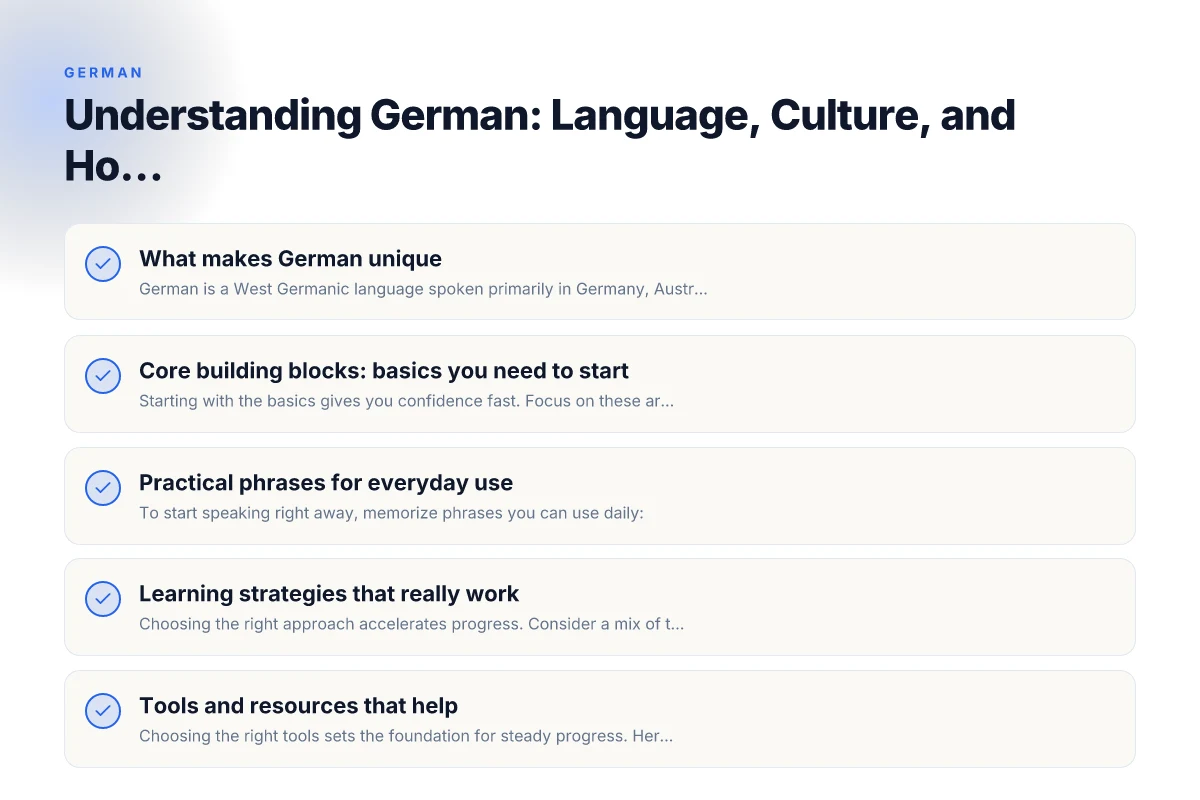
Core building blocks: basics you need to start
Starting with the basics gives you confidence fast. Focus on these areas:
- Greetings and polite phrases: Hallo, Guten Morgen, Gute Nacht, Bitte, Danke, Entschuldigung.
- Essential verbs: sein (to be), haben (to have), werden (to become), müssen (must), können (can).
- Basic nouns and everyday topics: Familie (family), Arbeit (work), Schule (school), Essen (food), Reisen (travel).
- Numbers, days, and time: Numbers 1–100, Wochentage (days of the week), Uhrzeit (time).
Pronunciation essentials
German pronunciation is performative but approachable. Key tips:
- Vowels: a, e, i, o, u with umlauts (ä, ö, ü) change sounds; ü and ö require a forward tongue position.
- Consonants: j sounds like y in yes. V is typically f. W is v. S is soft at the start of syllables but sharp between vowels.
- Final consonants: Often pronounced. Unlike some languages where final consonants are muted.
- Stress: Most German words are stressed on the first syllable, but there are exceptions.
Grammar at a glance
A short map of essential grammar helps you avoid common pitfalls: Dummy text: what it is, where it comes from, and how to use it
- Noun gender and articles: der (masc), die (fem), das (neut), with plural die.
- Cases: nominative (subject), accusative (direct object), dative (indirect object), genitive (possession or close relation, rarely used in everyday speech).
- Verbs: Regular and irregular verb conjugations. Modal verbs modify meaning (können, müssen, dürfen, wollen, sollen, mögen).
- Sentence structure: In main clauses, the verb often appears in the second position. In subordinate clauses, the verb goes to the end.
Practical phrases for everyday use
To start speaking right away, memorize phrases you can use daily:
- I would like: Ich möchte
- Do you speak English?: Sprechen Sie Englisch?
- Where is the bathroom?: Wo ist die Toilette?
- How much does it cost?: Wie viel kostet das?
- I don’t understand: Ich verstehe nicht
- Please help me: Bitte helfen Sie mir
- I’m learning German: Ich lerne Deutsch
Learning strategies that really work
Choosing the right approach accelerates progress. Consider a mix of these methods:
- Spaced repetition: Use flashcards (digital or physical) to retain vocabulary over time.
- Immersion: Listen to German music, podcasts, radio, and watch shows with subtitles.
- Speaking practice: Find language partners, tutors, or conversation groups. Even talking to yourself in German builds fluency.
- Reading and listening at your level: Start with graded readers or news tailored for learners, then gradually increase difficulty.
- Writing practice: Keep a daily journal, compose short emails, or participate in online forums in German.
A simple weekly plan
- Monday: 20 minutes vocabulary + 10 minutes pronunciation drill
- Tuesday: 20 minutes grammar focus (cases or verb tenses) + 10 minutes listening
- Wednesday: 30 minutes speaking with a partner (or mirror speaking)
- Thursday: 20 minutes reading a short article + 10 minutes note-taking
- Friday: 20 minutes writing (journal or messages)
- Weekend: 1–2 immersion sessions (watch a film/series. Listen to a podcast)
Tools and resources that help
Choosing the right tools sets the foundation for steady progress. Here are options you can mix and match:
- Apps for vocabulary and grammar: Anki, Duolingo, Babbel, Memrise
- Grammar guides and phrasebooks: Deutsche Grammatik, Langenscheidt phrasebooks
- Listening practice: Deutsche Welle (DW) courses, easy German YouTube channels, podcasts like Coffee Break German
- Reading materials: graded readers, children’s books, news sites like Nachrichtenleicht
- Speaking platforms: italki, Tandem, local language exchanges, conversation clubs
A quick comparison: learning approaches
| Approach | Strengths | Ideal for | Potential drawbacks |
|---|---|---|---|
| Immersion (media, real conversations) | Realistic language use, cultural nuance | Long-term learners aiming for fluency | May be overwhelming for beginners |
| Structured courses (classroom, app courses) | Clear progression, measure progress | Beginners and early intermediate | Can feel repetitive or slow without extra practice |
| Self-study with flashcards | Efficient vocabulary build, flexible | Busy learners, focus on recall | May neglect speaking and listening if not paired with practice |
| Tandem/Conversation exchange | Pronunciation, real-time feedback | Learners who want speaking confidence | Availability of partners, differing levels |
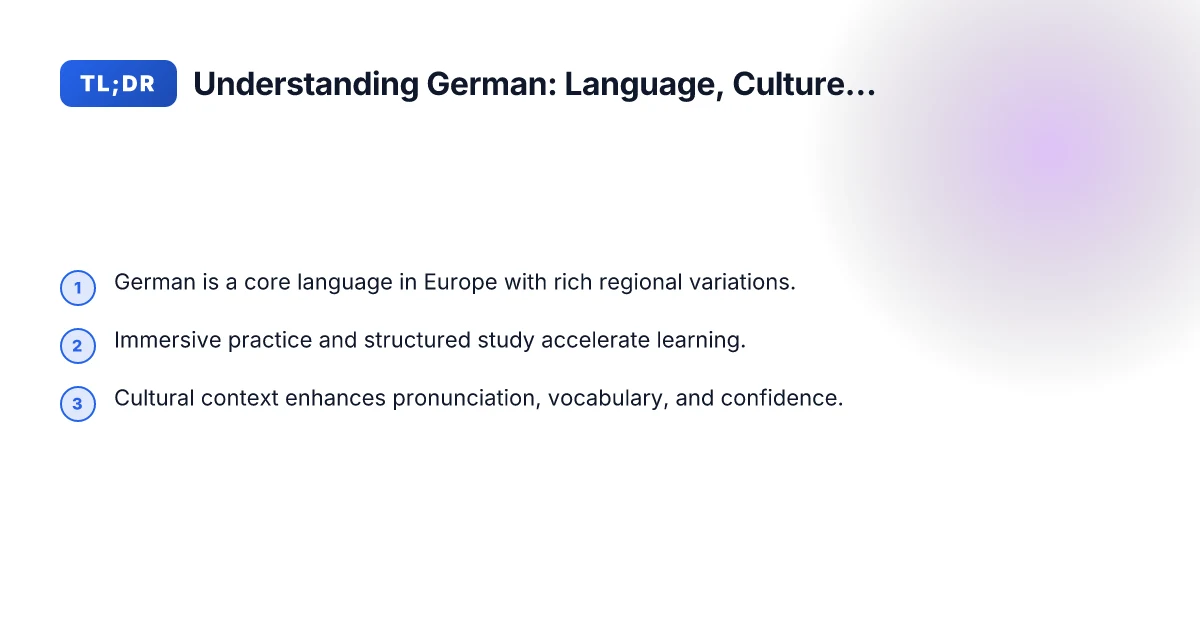
The cultural layer: context matters
Language and culture go hand in hand. Understanding German-speaking cultures helps you sound natural and navigate social situations more smoothly: Courses you can take to level up your skills in 2024 and beyond
- Politeness and formality: Use Sie for strangers or elders in professional settings. Switch to du once invited.
- Punctuality and planning: Germans value timeliness and clear schedules. Plan ahead for meetings and travel.
- Regional diversity: Dialects differ by region (Bavarian, Swabian, Swiss German, Austrian variants). You may encounter differences in vocabulary and pronunciation.
- Food and social rituals: Sharing meals is common. Know basic food-related terms and how to express preferences politely.
Core building blocks vs. learning tools
| Building block | Example tools | Where it shines | When to use | Beginner hurdle | Notes |
|---|---|---|---|---|---|
| Pronunciation basics | Phonetics videos, mouth diagrams | Early confidence | Start | Sound differences | Practice aloud daily |
| Basic grammar concepts | Simple verb tenses cheat sheets | Quick foundation | Weeks 1–4 | Complex cases feel abstract | Revisit often |
| Core vocabulary | Frequency word lists | Quick utility | Ongoing | Memory load | Spaced repetition helps |
| Practical phrases | Dialogue audio, phrasebooks | Everyday readiness | Weeks 2–6 | Context mistakes | Learn in context |
| Listening comprehension | Short podcasts, children's shows | Realistic listening | Ongoing | Speed and accents | Subtitles optional over time |
| Reading basics | Graded readers, short articles | Vocabulary growth | Weeks 4–8 | Guessing meaning | Highlight new words |
Compiled November 2026; check the provider's site for current details.
Troubleshooting common beginner challenges
- Struggling with cases: Practice with real sentences, use articles in practice, and gradually build a mental map of how each case changes nouns, pronouns, and adjectives.
- Getting lost in long nouns: Break down long compounds into meaningful parts to understand the meaning.
- Pronunciation hurdles: Record yourself. Compare with native speakers. Practice minimal pairs to distinguish sounds.
- Fear of making mistakes: Remember that mistakes are essential for learning. Start with simple sentences and gradually increase complexity.
A short plan to reach conversational German in 3–6 months
- Build a 500–1000 word essential vocabulary covering everyday topics.
- Master the present tense and basic modal verbs. Practice common sentence patterns.
- Practice speaking twice weekly with a partner or tutor. Integrate pronunciation work.
- Engage with short listening material daily. Combine with reading simple texts.
- Expand to past and future tenses as you gain confidence. Keep a growing notebook of phrases.
Quick decision guide for learning plan
| Goal | Timeframe | Recommended path | Key milestone | Check-in method | Expected outcome |
|---|---|---|---|---|---|
| Conversational German in 3–6 months | 12–24 weeks | Structured online course + weekly speaking practice | Biweekly speaking demo | Self-recordings + tutor feedback | Basic conversations around familiar topics |
| Everyday phrases fast | 8–12 weeks | App-based drills + phrase practice | Finish essential phrases list | End-of-week mini-conversation | Able to handle daily scenarios |
| Culture-aware language | 6–9 months | Immersion elements + cultural modules | 1 cultural topic/month | Journal + reflection | Contextual understanding in conversations |
Compiled November 2026; check the provider's site for current details. Contactanos: how to reach Spanish-speaking support and what to expect
Final recommendations
If you’re starting today, pick a balanced approach that blends structured study with real-world practice. Use a beginner-friendly course or app to build a solid foundation, then supplement with daily listening and weekly speaking sessions. Track your progress, celebrate small wins, and gradually push toward more natural conversation.
For most learners, an anchor plan combining spaced repetition for vocabulary, short daily listening, and weekly speaking sessions yields steady results. Stay curious about the culture, not just the grammar, and you’ll find German becomes less of a puzzle and more of a tool for connection.