Courses you can take to level up your skills in 2026 and beyond
A practical guide to choosing and succeeding in courses that boost skills, career prospects, and personal growth.
The world of courses is vast, and choosing the right one can feel overwhelming. Whether you want to learn a new skill, switch careers, or deepen expertise in your current field, there’s a course path that fits your goals, schedule, and budget. This guide will help you navigate the landscape, decide what to study, and make the most of your learning journey.
Quick comparison of course formats (online, in-person, hybrid)
| Format | Typical duration | Interaction level | Access to recordings | Best for | Average cost (rough) |
|---|---|---|---|---|---|
| Online | weeks to months | high (forums, chats) | yes | self-paced learners | low to mid |
| In-person | hours to weeks | high (live) | no | hands-on, networking | mid to high |
| Hybrid | mix of both | moderate | partial | flexible schedules | mid |
Compiled November 2026; check the provider's site for current details.
What a course is and why it matters
Courses are structured learning experiences designed to teach specific skills or knowledge. They can range from short, focused modules to multi-month programs. The best courses align with clear outcomes, such as “build a basic Python app” or “execute a digital marketing plan for a real brand.”
Key reasons to enroll in courses:
- Earn essential skills for a current or desired job
- Learn new tools and technologies that are in demand
- Build a portfolio or demonstrable projects
- Meet peers and mentors who can support your career
Think about your goal before choosing a course: what problem are you trying to solve, and what does success look like for you?
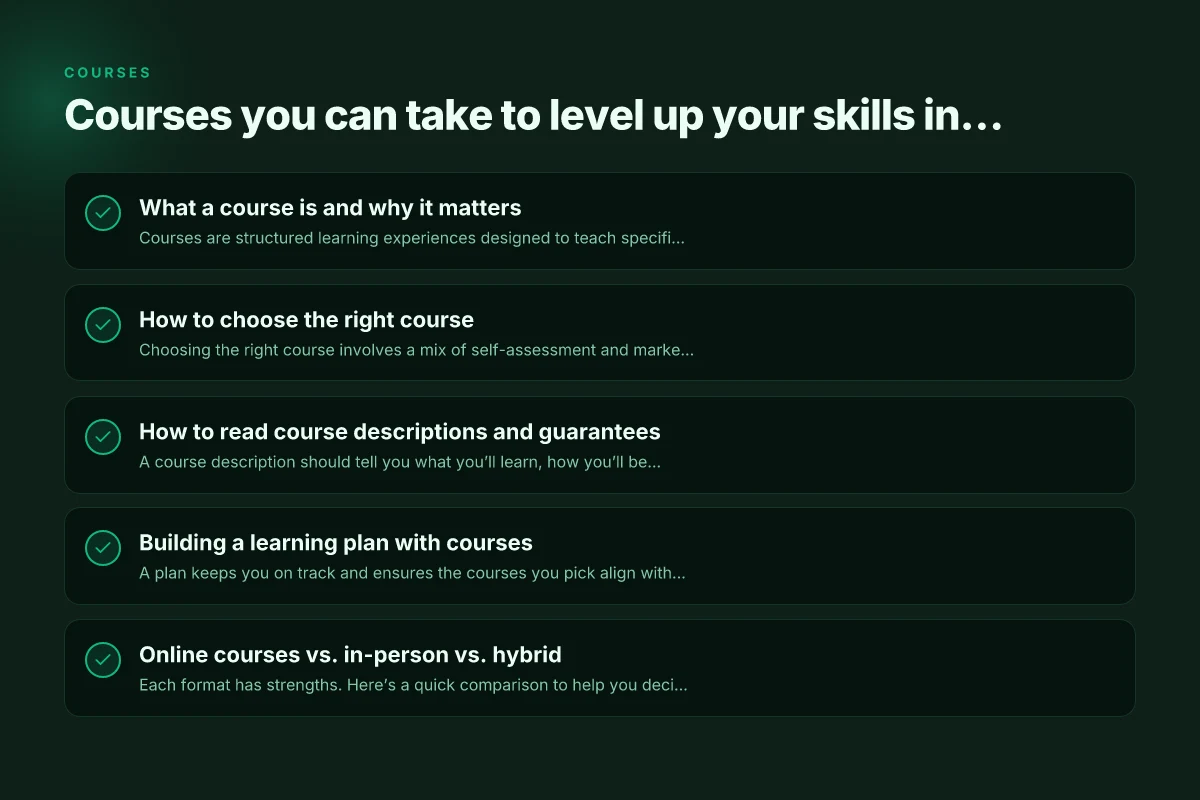
How to choose the right course
Choosing the right course involves a mix of self-assessment and market reality. Here’s a practical checklist: Contactanos: how to reach Spanish-speaking support and what to expect
- Define your objective: certification, job-ready skills, or personal enrichment?
- Assess your level: beginner, intermediate, or advanced?
- Look at outcomes: what projects or credentials will you have by the end?
- Review the format: self-paced vs. cohort-based, live instructors vs. pre-recorded
- Check the reputation: provider credibility, course reviews, and alumni success
- Consider the time and cost: total hours, weekly commitment, and tuition
- Plan for practice: are there labs, projects, or real-world applications?
- Verify support: access to instructors, TA help, and community
Formats you’ll encounter:
- Online courses: flexible, often self-paced, wide variety
- In-person classes: structured schedule, hands-on labs, networking
- Hybrid courses: mix of online theory and in-person practice
- Micro-courses and bootcamps: intensive, focused, fast to completion
- University or college credit courses: formal accreditation
How to read course descriptions and guarantees
A course description should tell you what you’ll learn, how you’ll be taught, and how you’ll know you’ve succeeded. Look for:
- Learning outcomes: specific skills and knowledge you’ll gain
- Syllabus snapshot: major topics and project requirements
- Assessment methods: quizzes, projects, capstones, or exams
- Time commitment: total hours, weekly schedule, and pace
- Prerequisites: what you should know before starting
- Delivery method: video lectures, readings, labs, discussions
- Community and support: access to cohorts, mentors, or office hours
Some programs offer guarantees or outcomes-focused promises, such as a money-back option if you don’t complete or if you don’t gain certain skills after finishing. Be wary of ambiguous promises. Seek tangible metrics and reviews.
How to read course descriptions and guarantees Contact US fr
| Element | What it means | Typical phrasing to look for | What to watch out for | Your check (yes/no) | Example verdict |
|---|---|---|---|---|---|
| Duration | total time | “8 weeks” vs “self-paced” | vague timeframes | ||
| Delivery mode | online, in-person, hybrid | “live sessions” | hidden formats | ||
| Assessments | exams, projects | “final project” | heavy testing | ||
| Guarantees | refund, completion | “30-day refund” | strict criteria |
Compiled November 2026; check the provider's site for current details.
Building a learning plan with courses
A plan keeps you on track and ensures the courses you pick align with your goals. Here’s a simple framework:
- Define the goal: what job, project, or skill do you want to achieve?
- Break it into milestones: for example, “learn basics,” “build a portfolio,” “attain certification.”
- Map courses to milestones: select 2–4 courses that cover each milestone
- Set a timeline: assign start dates and end dates with buffer time
- Build in practice: add hands-on projects, side studies, or a portfolio
- Review and adjust: every 4–6 weeks, measure progress against goals
Tip: Start with a short, low-cost introductory course to test your interest before committing to longer programs.
Online courses vs. in-person vs. hybrid
Each format has strengths. Here’s a quick comparison to help you decide: Cmsms: A Practical Guide to Understanding and Using the CMSMS Content Management System
- Online courses
- Pros: flexibility, vast choices, often lower cost
- Cons: requires self-discipline, less direct interaction
- In-person courses
- Pros: real-time feedback, hands-on labs, networking opportunities
- Cons: fixed schedule, travel or commute, sometimes higher cost
- Hybrid courses
- Pros: balance of flexibility and community, flexible deadlines with live sessions
- Cons: requires good time management, sometimes higher coordination
Tip: If you’re balancing work or family, online or hybrid formats are usually the best fit. If you thrive on live interaction and accountability, in-person may be more effective.
The price of courses and finding value
Cost varies widely. Common price bands include free (or very low-cost) MOOCs, low-cost certificates, and premium bootcamps or degree programs. Consider these value factors:
- Credentials and recognition: a certificate, micro-credential, or degree
- Project-based evidence: a portfolio you can show employers
- Alumni outcomes: job placements, promotions, salary gains
- Support and community: mentoring, cohorts, and networking
- Long-term usefulness: does the course teach adaptable skills or just a tool
- Hidden costs: software licenses, exam fees, or travel
Cost-saving strategies:
- Look for scholarships, employer sponsorships, or nonprofit providers
- Choose a course with transferable skills rather than a single tool
- Combine a free introductory course with a paid capstone to build a portfolio
Cost-friendly tips: Allemand: A Practical Guide to Understanding and Using the Word in Language and Culture
- If you’re unsure about a topic, start with a free or low-cost introductory course
- Use trial periods to test the teaching style and pacing
- Avoid paying for long programs before you complete a few modules
A simple comparison table: popular course categories
| Category | Typical goal | Common formats | Time to completion | Example outcomes | | Software development | Build apps, automate tasks | Online bootcamps, university courses, self-paced | 6–24 weeks (bootcamps) | A portfolio project, job-ready skills | | Data science / analytics | Analyze data, model trends | Online courses, micro-credentials, bootcamps | 8–16 weeks (short programs) | Data project, dashboard, report | | Digital marketing | Grow brands, run campaigns | Short courses, certificates, live cohorts | 4–12 weeks | Campaign plan, metrics sheet | | Design and UX | Create intuitive products | Online courses, bootcamps, university courses | 4–20 weeks | Wireframes, case study, portfolio | | Project management | Lead teams and initiatives | Certificates, degree, workshops | 4–12 weeks | Certification, project plan toolkit | | Language and soft skills | Communicate effectively | Online modules, live classes | 4–12 weeks | Conversation ability, resume skills |
Note: Times are approximate and vary by provider and depth. Look for courses that include a capstone or portfolio to demonstrate your learning.
A simple comparison table: popular course categories
| Category | Skill focus | Typical career impact | Entry barrier | Time to value | Common formats |
|---|---|---|---|---|---|
| Data Science | analytics, ML | high | medium | short to medium | online, bootcamps |
| Web Development | front-end, back-end | strong | low | short | online, bootcamps |
| Project Management | PM basics, Agile | versatile | low | short | online, self-paced |
| Digital Marketing | SEO, ads | adaptable | low | short | online, short courses |
| Cybersecurity | threat, defense | growing | medium | medium | online, bootcamps |
| UI/UX Design | research, design | creative roles | medium | medium | online, workshops |
Compiled November 2026; check the provider's site for current details. Aleman: A Clear Guide to the Term, Its Uses, and Cultural Context
How to maximize success in any course
- Set a dedicated study space and schedule 2–5 hours weekly, then protect that time.
- Engage actively: participate in forums, join study groups, ask questions, seek feedback.
- Do all practical work: build projects, run experiments, and document your process.
- Seek mentors or peers: a support network improves motivation and accountability.
- Track progress: keep a learning journal with goals, achievements, and adjustments.
- Apply what you learn: find real tasks, volunteer, freelance, or side-projects.
- Prepare for outcomes: update your resume, portfolio, and LinkedIn with new skills and projects.
When a course should be part of a bigger plan
Courses work best when integrated into a broader strategy:
- For career changes: pair courses with networking, internships, or freelance work.
- For promotions: target courses that demonstrate impact, such as leading a project or delivering measurable results.
- For personal growth: mix skill-based courses with topics that broaden your perspective, such as communication or critical thinking.
Consider combining multiple short courses into a larger roadmap, rather than investing in a single long program without a clear endpoint or portfolio.
The final recommendation
If you’re starting today, pick a goal-driven two-course plan:
- Course 1: A beginner-friendly, project-based program in a high-demand area relevant to your career, with a visible capstone or portfolio.
- Course 2: A complementary skill or a more advanced topic that directly enhances your project outcomes or job responsibilities.
Begin with one course that aligns most closely with your immediate objective, and back it up with a second course that expands your capabilities or reinforces what you learned. Throughout, prioritize courses that offer tangible outcomes, such as projects, certifications, or an updated portfolio. And as you progress, continuously apply what you learn to real-world tasks, seek feedback, and adjust your plan based on outcomes. Dummy text: what it is, where it comes from, and how to use it
If you’d like, tell me your current goal, your industry, and how much time you can invest weekly. I can tailor a two- to four-course plan with specific providers, formats, and a realistic timeline that suits your situation.