Test8: What it Means and How to Use It
A clear, practical guide to understanding and applying test8 in your projects.
test8 appears as a label that can mean different things depending on the domain, so to answer the search intent clearly, we’ll treat test8 as a versatile testing or evaluation concept that you can tailor to your needs. Whether you’re a developer, QA engineer, or product manager, understanding how to apply test8 helps you design better tests, gather meaningful data, and improve outcomes.
What test8 is vs what it isn’t
| Attribute | Test8 present | Test8 absent | Practical implication |
|---|---|---|---|
| Core purpose | yes | no | guides use |
| Scope | defined | undefined | helps planning |
| Typical users | developers, testers | none | targets audience |
| Required tooling | lightweight | heavy | setup effort |
| Measurement objective | yes | no | evaluation exists |
| Reusability across projects | yes / partial | no | leverage value |
| Documentation burden | moderate | high | traceability |
| Training needed | minimal | extensive | adoption pace |
Compiled November 2026; check the provider's site for current details.
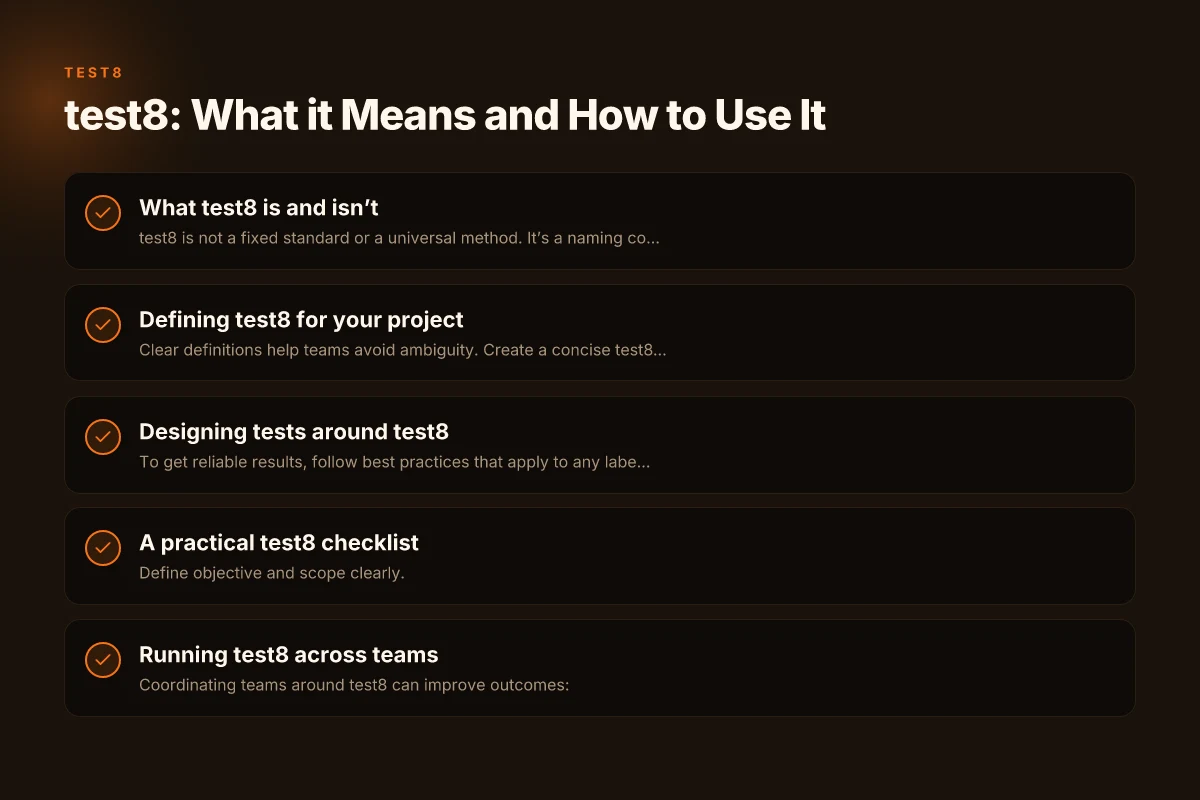
What test8 is and isn’t
test8 is not a fixed standard or a universal method. It’s a naming convention or a placeholder you can customize. Think of test8 as:
- A specific test case or scenario you want to run.
- A step in a testing plan that you label for easy reference.
- A checkpoint in a workflow where you verify a particular behavior or metric.
Key point: the value of test8 comes from how you define its scope, inputs, expected results, and success criteria.
How people typically use test8
to organize tests, compare outcomes, or tag a subset of checks for quick iteration. Common patterns include:
- Tagging: test8 identifies a set of tests that share a common goal.
- Versioning: test8 marks the eighth iteration of a test plan.
- Scenario labeling: test8 names a particular user journey or edge case.
Clarify before you start
Before you implement test8, pin down: Test7: A Practical Guide to Understanding and Using test7 Effectively
- Objective: What are you trying to verify or measure?
- Scope: Which components, environments, or data sets are involved?
- Success criteria: How will you know test8 passed or failed?
- Inputs and mocks: What data or services do you need, and what should be mocked?
Defining test8 for your project
Clear definitions help teams avoid ambiguity. Create a concise test8 brief that includes:
- Title: A short, descriptive name.
- Purpose: Why this test matters.
- Preconditions: What must be in place before running the test.
- Steps: A numbered list of actions to perform.
- Expected results: The concrete outcomes that indicate success.
- Postconditions: What to revert or clean up afterward.
Example template
- Title: test8 verifies checkout flow with a coupon.
- Purpose: Ensure discount coupons apply correctly and do not affect tax calculation.
- Preconditions: User logged in, cart has items, coupon code exists.
- Steps:
- Add items to cart.
- Apply coupon COUPON20.
- Proceed to checkout.
- Complete payment.
- Expected results:
- Coupon discount is visible and applied.
- Tax and total reflect the discount.
- Order completes successfully.
- Postconditions: Order is created. Coupon remains unused for others if single-use.
Designing tests around test8
To get reliable results, follow best practices that apply to any labeled test, including test8:
- Use realistic data: Create inputs that resemble real user behavior.
- Isolate changes: Run test8 in an environment where you control variables.
- Repeatability: Ensure the test yields the same result under the same conditions.
- Observability: Collect logs, screenshots, or metrics to explain outcomes.
- Clean up: Remove test data to avoid polluting the environment.
What to measure with test8
- Functional correctness: Does the feature work as intended?
- Performance impact: Does test8 affect response times or resource use?
- Security and privacy: Are there any exposure or authorization issues?
- User experience: Is the flow intuitive and free of friction?
- Stability: Does the feature degrade gracefully under load?
Defining test8 for your project — decision factors
| Factor | Yes / No | How it affects decision | Recommended action |
|---|---|---|---|
| Need for a clear definition | yes | ensures alignment | adopt and define scope |
| Existence of existing standards | yes / no | compatibility | map to current standards |
| Team readiness | high / medium / low | adoption likelihood | plan training |
| Timeline constraint | tight / flexible | urgency | adjust scope or schedule |
| Tooling availability | yes / no | setup effort | choose lightweight tools |
| Documentation capacity | yes / no | governance | write concise docs |
Compiled November 2026; check the provider's site for current details. Test: a practical guide to understanding, using, and evaluating tests
A practical test8 checklist
- Define objective and scope clearly.
- Identify required data and dependencies.
- Write explicit steps with expected results.
- Prepare assertion points and pass/fail criteria.
- Configure the environment and data isolation.
- Execute and record results.
- Review failures and update test8 if needed.
- Archive results for audit and future reference.
A simple comparison table to plan test8 variants
| Variant | Focus | Data needs | Environment | Expected outcome | Notes |
|---|---|---|---|---|---|
| test8-A | Functional validation | Sample cart items, valid coupon | Staging | Coupon applies, order completes | Use real coupon logic |
| test8-B | Negative path | Invalid coupon | Staging | Coupon ignored, error message shown | Test message content |
| test8-C | Performance | Concurrent checkout requests | Staging under load | Response time within SLA | Peak load scenario |
| test8-D | Security | Unauthorized access attempt | Staging | Access denied, logs generated | Audit trail important |
Running test8 across teams
Coordinating teams around test8 can improve outcomes:
- QA: Create and execute test8 cases, track defects.
- Dev: Implement fixes or improvements revealed by test8 results.
- Product: Validate whether test8 aligns with user value and business goals.
- Data/Analytics: Collect metrics to quantify test8 impact.
Documentation and governance
Documenting test8 decisions supports consistency:
- Version-control your test8 briefs and artifacts.
- Maintain a centralized repository of test8 results.
- Update success criteria as the product evolves.
- Conduct periodic reviews to refine test8 definitions.
Designing tests around test8 — options and tradeoffs
| Design option | Feature support | Pros | Cons | Suggested use |
|---|---|---|---|---|
| Test8-centric checklist | yes | clarity, consistency | may feel rigid | early phase governance |
| Lightweight templates | yes | fast adoption | risk of gaps | quick projects |
| Cross-team guidelines | yes | consistency | coordination needed | multi-team programs |
| Formal criteria with metrics | yes | objective measurement | heavier process | high-stakes projects |
| Lightweight narrative narratives | yes | accessibility | less precision | exploratory work |
Compiled November 2026; check the provider's site for current details. Study spanish in Mexico group course san cristobal de las casas chiapas Mexico
Pitfalls to avoid with test8
- Ambiguity: Vague objectives lead to inconsistent results.
- Overfitting: Tailoring test8 too narrowly to a single scenario reduces generalizability.
- Scope creep: Adding too many steps makes the test brittle.
- Poor data hygiene: Using stale or invalid data corrupts results.
- Neglecting cleanup: Leftover test data can affect future tests.
Quick tips to keep test8 effective
- Start with a small, high-value scope and expand gradually.
- Enforce a naming convention so test8 remains identifiable.
- Automate where possible, but keep readability for humans.
- Review results with stakeholders and translate findings into actionable fixes.
When to retire or rename test8
If test8 ceases to provide value, consider:
- Replacing it with a more descriptive name that reflects its purpose.
- Breaking it into smaller, more focused tests.
- Consolidating it with related tests to reduce duplication.
- Archiving old results to prevent confusion.
Alternatives to test8 naming
- Use descriptive labels: test_checkout_coupon_validation, test_user_onboarding_flow_v2.
- Group by objective: functional_test, performance_test, security_test.
- Version-based naming: test8_v1, test8_v2, etc., if iteration tracking is needed.
Final recommendations
- Start with a precise definition of what test8 should cover in your context.
- Create a concise brief with objective, steps, and clear success criteria.
- Use a mix of functional, negative, performance, and security angles as appropriate.
- Document results, learnings, and any adjustments for future runs.
- Revisit test8 periodically to ensure it stays relevant as the product evolves.
If you’d like, I can help tailor a test8 plan to your specific project stack, environment, and goals, including sample test cases, data sets, and automated checks.