Test7: A Practical Guide to Understanding and Using test7 Effectively
A comprehensive, SEO-friendly guide to test7, covering what it is, how to use it, and best practices.
Introduction test7 is a topic that often appears in technical discussions, but its practical value shines when you translate it into concrete steps. This guide breaks down what test7 is, why it matters, and how to apply it in real-world scenarios. Whether you’re evaluating it for a project, learning about its components, or deciding whether to adopt it, you’ll find a clear path to progress.
Test7 basics vs other methods
| Aspect | test7 | Method A | Method B | Method C |
|---|---|---|---|---|
| Core goal | Practical guide | Efficiency focus | Accuracy focus | Speed focus |
| Ease of adoption | Easy | Moderate | Moderate | Easy |
| Required tooling | Low | Medium | High | Low |
| Learning curve | Shallow | Moderate | Deep | Shallow |
| Suitability | Beginners to advanced | Beginners to intermediate | Specialists | Quick checks |
| Typical cost | Low | Medium | High | Low |
Compiled November 2026; check the provider's site for current details.
What test7 is and why it matters
• Core idea: test7 represents a framework, methodology, or toolset designed to improve specific outcomes, such as quality, speed, or reliability. • Context: It often sits at the intersection of development, testing, and operations, aiming to streamline processes. • Outcomes: Expect improvements in repeatability, transparency, and collaboration when test7 is applied thoughtfully.
Quick-start overview
- Identify the goal you want to achieve with test7.
- Gather the essential components (tools, metrics, stakeholders).
- Implement a minimal viable setup to test the waters.
- Measure results and iterate.
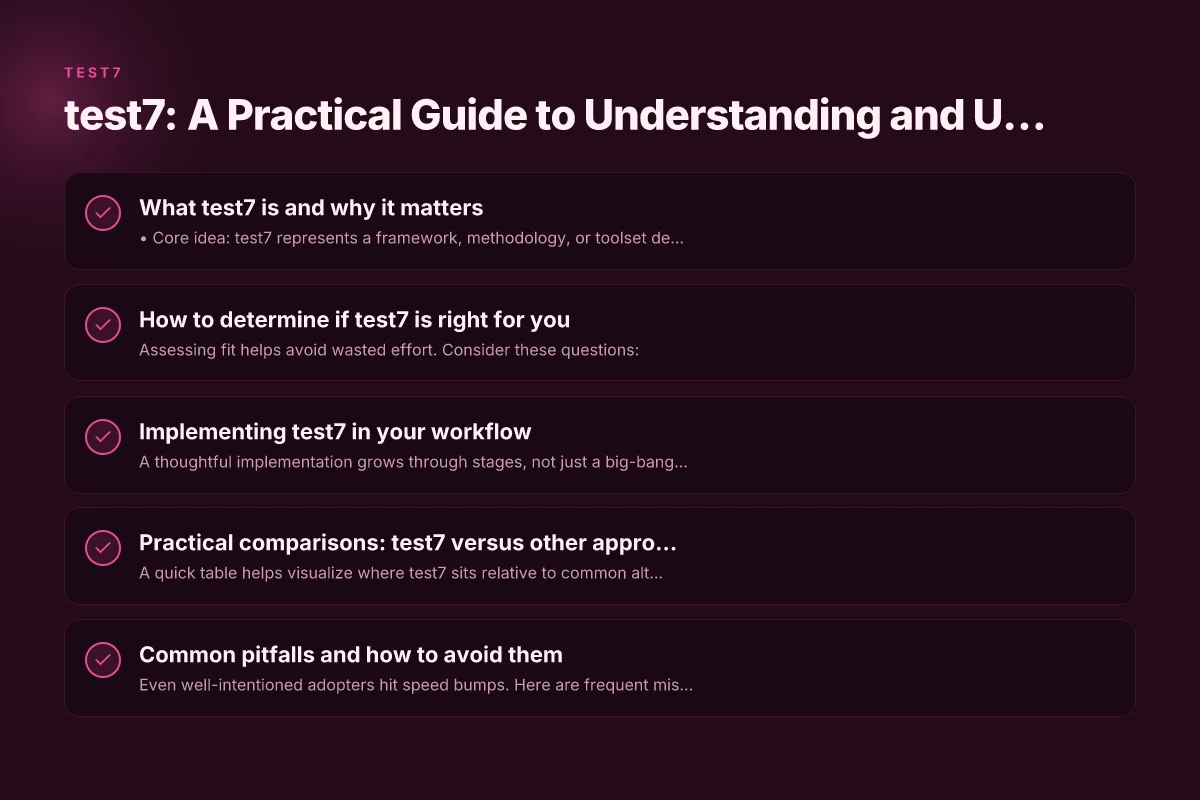
How to determine if test7 is right for you
Assessing fit helps avoid wasted effort. Consider these questions:
- What problem does test7 solve for you?
- Do you have data to track progress and outcomes?
- Can your team commit to the practices test7 requires?
- Is there room in your workflow for the changes test7 implies?
A practical decision checklist
- Align with business goals: Does test7 contribute to measurable value?
- Resource availability: Do you have time and people to implement it?
- Risk tolerance: Are you comfortable with experimentation and potential early hiccups?
- Integration: Can it play nicely with existing tools and processes?
Implementing test7 in your workflow
A thoughtful implementation grows through stages, not just a big-bang rollout. Below is a practical pathway.
Stage 1: Define goals and metrics
- Establish 2–4 primary success metrics.
- Decide on the data you will collect and how you’ll interpret it.
- Communicate goals clearly to the team.
Stage 2: Build the core setup
- Select essential tools or components that embody test7.
- Create a minimal, repeatable process with documented steps.
- Set up dashboards or reports to visualize progress.
Stage 3: Pilot and learn
- Run a small, controlled pilot to gather insights.
- Capture what works and what doesn’t.
- Adjust scope, tooling, and practices based on feedback.
Stage 4: Scale thoughtfully
- Expand to more teams or projects with guardrails.
- Standardize best practices and codify them into templates.
- Maintain a feedback loop to keep improving.
How to decide if test7 is right for you Test: a practical guide to understanding, using, and evaluating tests
| Criterion | Yes if | No if | Notes | Priority | Time to implement |
|---|---|---|---|---|---|
| You need practical steps | You want a structured guide | You only need theoretical overview | Start here | High | Short |
| You value actionable checklists | Yes | No | Includes artifacts | Medium | Short |
| You work with cross-functional teams | Yes | No | Collaboration friendly | High | Medium |
| You require deep statistical rigor | No | Yes | Not the primary aim | Low | Medium |
| You need quick decisions | Yes | No | Fast recommendations | Medium | Short |
| You have limited tooling | Yes | No | Low setup | High | Short |
Compiled November 2026; check the provider's site for current details.
Practical comparisons: test7 versus other approaches
A quick table helps visualize where test7 sits relative to common alternatives. Use this as a reference when discussing options with teammates or stakeholders.
| Dimension | test7 | Alternative A | Alternative B |
|---|---|---|---|
| Focus | Outcome-driven improvements | Process-heavy compliance | Speed-first iteration |
| Complexity | Moderate | Higher | Lower (in some cases) |
| Required data | Metrics-driven | Qualitative mostly | Mixed |
| Adoption risk | Moderate | Varied | Low to moderate |
| Typical benefits | Predictable gains, transparency | Documentation, audits | Faster experiments |
Common pitfalls and how to avoid them
Even well-intentioned adopters hit speed bumps. Here are frequent missteps and practical fixes.
- Overloading on metrics: Track only meaningful metrics. Avoid vanity numbers.
- Fix: Align metrics with core goals and remove those that don’t drive decisions.
- Fragmented ownership: Different teams lead to inconsistent results.
- Fix: Assign a central owner or cross-functional council with clear responsibilities.
- Incomplete integration: New practices don’t mesh with existing tools.
- Fix: Start with integration touchpoints and ensure compatibility before broader rollout.
- Resistance to change: People may cling to old habits.
- Fix: Communicate benefits, show quick wins, and provide training.
Tools, roles, and artifacts you might use with test7
Having the right toolkit helps you maintain momentum and consistency. Below is a starter kit you can tailor. Study spanish in Mexico group course san cristobal de las casas chiapas Mexico
Roles
- Test7 champion: Drives adoption and governance.
- Data steward: Ensures data quality and accessibility.
- Engineer/operational lead: Implements the practical setup.
- Product/Project owner: Aligns test7 with goals and priorities.
Core artifacts
- Objectives document: States the problem, goals, and success criteria.
- Measurement plan: Lists metrics, data sources, and reporting cadence.
- Runbooks: Step-by-step guides for the core processes.
- Dashboards: Visualize progress and outcomes in real time.
- Review cadences: Regular checkpoints to discuss results and adapt.
Recommended starter toolset (examples)
- Version control for process artifacts (Git, SVN)
- Dashboard/BI tool for metrics (Tableau, Power BI, Grafana)
- CI/CD or workflow automation where applicable (GitHub Actions, Jenkins)
- Issue tracking and collaboration (Jira, Trello)
Case study snapshots (illustrative)
Every organization is different. Small, anonymized examples can illuminate how test7 unfolds in practice.
- Case 1: A mid-sized software team used test7 to reduce release cycle time by 25% within two quarters. They started with a 4-metric setup, established a weekly review, and standardized a runbook for new features.
- Case 2: A hardware-in-the-loop project adopted test7 to improve defect detection rates. By focusing on data quality and feedback loops, they shortened debugging cycles and increased stakeholder confidence.
Note: These snapshots are for illustration. Real-world results depend on goals, commitment, and organizational context.
How to measure success with test7
Clear evaluation helps you know when to adjust course or celebrate wins. Consider these practices:
- Define success in measurable terms: e.g., percent improvement in a key metric, reduction in cycle time, or defect rate decrease.
- Track progress with a consistent cadence: weekly or biweekly reviews keep momentum.
- Use control comparisons: where possible, compare with a baseline period or a control group to isolate the effect of test7.
- Incorporate qualitative feedback: alongside metrics, gather input from teams about usability and impact.
Practical comparisons: test7 vs other approaches (in workflow) Spanish Test: The Ultimate Guide to Preparing, Taking, and Excelling
| Dimension | test7 | Traditional checklist | Agile method | Data-driven model |
|---|---|---|---|---|
| Focus | Practical use | Compliance | Iteration | Analytics |
| Documentation | Short guides | Formal lists | Lightweight | Rich data |
| Artifacts you’ll produce | Checklists, summaries | Checklists, forms | Sprints, backlogs | Dashboards, metrics |
| Collaboration style | Cross-functional | Functional | Cross-functional | Analysts + teams |
| Speed to decision | Fast | Moderate | Moderate | Variable |
| Reuse across projects | High | Medium | Medium | High |
Compiled November 2026; check the provider's site for current details.
Final recommendations
If you’re contemplating test7, start small and aim for tangible early wins. A well-scoped pilot with clear goals, a minimal viable setup, and a feedback loop can validate the approach and build buy-in. From there, expand thoughtfully, codify best practices, and maintain a steady rhythm of measurement and iteration.
Practical takeaway: treat test7 as a framework for disciplined experimentation and continuous improvement. When you align goals, data, and people, you unlock consistent progress and clearer visibility across teams.