Registration Confirmation: What It Is, Why It Matters, and How to Handle It
A practical guide to understanding registration confirmations, what to expect, and steps to take if you don’t receive one.
Registration confirmation is a common step after signing up for an account, newsletter, event, or service. It reassures you that your submission went through and often provides next steps, such as verifying your email or completing profile details. In this article, you’ll learn what a registration confirmation is, why it matters, and how to handle typical scenarios, whether you’re the one sending confirmations or receiving them as a user.
Comparison of registration confirmation vs. event ticket vs. account activation
| Feature/Scenario | Purpose | Typical timing | Common user action required | Key benefits | Potential downsides |
|---|---|---|---|---|---|
| Registration confirmation | Acknowledges a registration | Immediate after signup | Check email/app | Verification, record, reassurance | May be ignored if not clear |
| Event ticket | Grants entry to an event | Issued before or at event | Present at entry | Scannable, holds seat/seat | Possible resale, loss risk |
| Account activation | Enables account use | After verification step | Click activation link | Access to services | Activation link expiry |
Compiled November 2026; check the provider's site for current details.
What is a registration confirmation?
A registration confirmation is an automated message or notice that confirms your sign-up was received and recorded by a system. It typically includes:
- The name of the service or event
- The date and time of your registration
- A reference or confirmation number
- Next steps (e.g., verify your email, complete profile, download tickets)
- Contact information for support
Concisely, it’s your receipt and a roadmap for what happens next. For some services, the confirmation is immediate. For others, it may take a few minutes, depending on processing time or additional verification requirements.
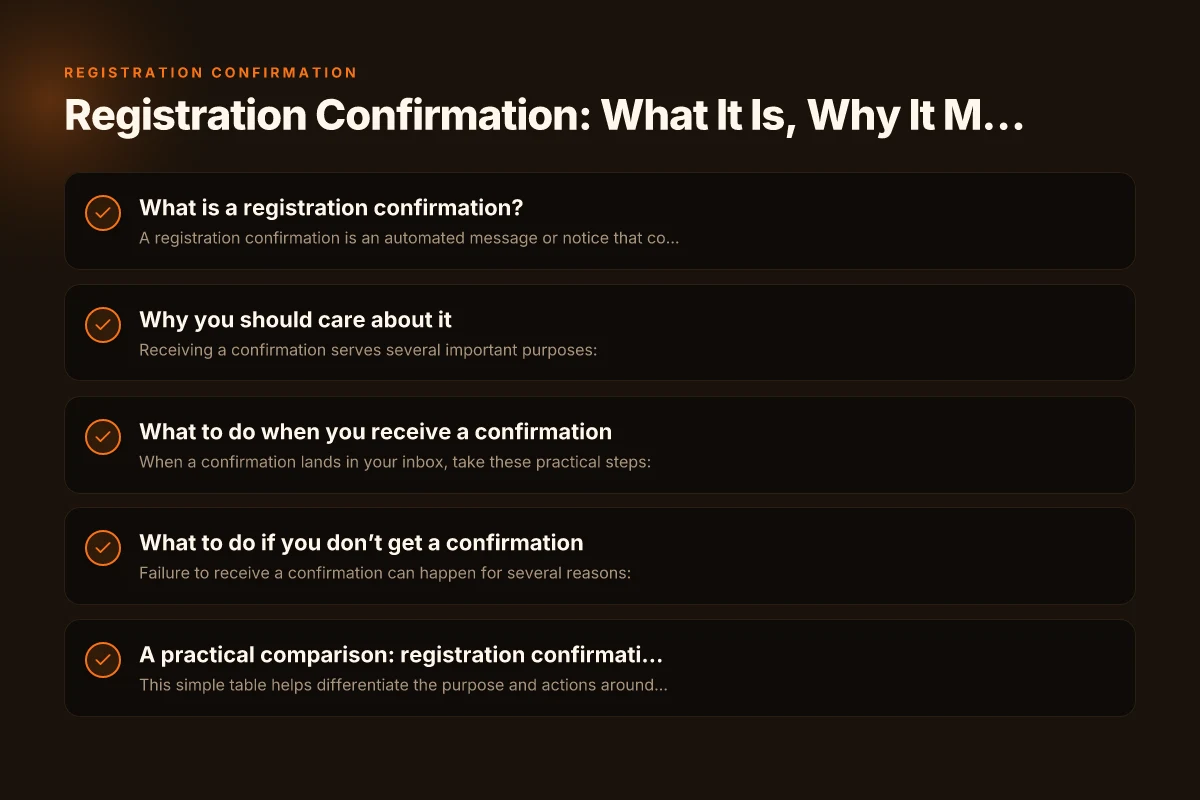
Why you should care about it
Receiving a confirmation serves several important purposes:
- Proof of enrollment: It confirms that your sign-up has been recorded and acknowledged.
- Security and verification: Some services require you to verify ownership of the email or account to prevent fraudulent sign-ups.
- Clarity on next steps: It guides you on what to do next, whether that’s clicking a verification link, completing a profile, or saving a reference number.
- Troubleshooting: If something goes wrong, the confirmation number or email provides a trackable reference for support.
If you don’t receive a confirmation, it can indicate a problem with the sign-up, an invalid email address, or a hiccup in the service’s system. It’s worth addressing promptly to avoid missing deadlines or access to resources. Prices discount spanish classes san cristobal
Best practices for organizations sending registration confirmations
| Practice area | Clear subject line | Sender name | Confirmation content | Delivery timing | Follow-up/next steps |
|---|---|---|---|---|---|
| Email design | Yes | Recognizable | Yes | Immediate | Provide next actions |
| Personalization | Yes (name) | Brand-aligned | Yes | On send | Optional welcome tips |
| Security | Use VERIFIED sender | Yes | Yes (privacy) | Timely | Include support contact |
| Visuals | Light, readable | Yes | Yes (summary) | Same day | Include FAQ link |
| Accessibility | Alt text, readable font | Yes | Yes (contrast) | Immediate | Verify with screen readers |
Compiled November 2026; check the provider's site for current details.
What to do when you receive a confirmation
When a confirmation lands in your inbox, take these practical steps:
- Save or bookmark the email: Keep it in a dedicated folder for easy retrieval.
- Read the instructions carefully: Look for verification links, next steps, deadlines, and any required documents.
- Verify your email if required: Some services ask you to click a link to confirm your address.
- Note the confirmation/reference number: This is useful if you need to contact support.
- Check for deadlines: Some registrations require action within a time window, such as 24–72 hours.
- Set a reminder: If there are upcoming tasks, add them to your calendar or task manager.
If the confirmation includes a downloadable ticket, receipt, or certificate, save a copy in multiple locations (cloud storage and local backup). This protects you in case of future access issues. Photo Gallery San Cristobal Chiapas: A Visual Guide to the City’s Best Images
What to do if you don’t get a confirmation
Failure to receive a confirmation can happen for several reasons:
- Email address error: A typo or incorrect entry can prevent delivery.
- Spam or junk filtering: Emails can be misclassified, especially from new domains.
- Delayed processing: Some systems queue sign-ups for batch processing.
- Technical issues: Server problems or outages can interrupt delivery.
Steps to take:
- Re-check the registration page: Confirm you completed all required fields and submitted successfully.
- Look for a “resend confirmation” option: Some services let you send the confirmation again.
- Check spam/junk and other folders: Promotions and social tabs are common homes for confirmations.
- Verify your email address: If you have an account settings or profile page, confirm there’s no typo.
- Try a different email address: If possible, test with another email to see if the issue is domain-related.
- Contact support with details: Provide your name, registration date/time, and any reference numbers you have.
If you still don’t receive a response after a reasonable period, escalate to a supervisor, or use social channels where the service maintains a support presence. Document dates and any attempts to resolve the issue so the team can assist efficiently.
A practical comparison: registration confirmation vs. event ticket vs. account activation
| Type | What it typically includes | When you should act | How to resolve common issues |
|---|---|---|---|
| Registration confirmation (general) | Acknowledgment, reference number, next steps | Immediately after sign-up; verify as needed | Check spam, verify email, contact support if missing |
| Event ticket confirmation | Ticket or QR code, event details, venue information | Before the event date; ensure you can access the ticket | Re-send ticket, confirm attendee list, check spam |
| Account activation confirmation | Verification link, welcome message, initial setup steps | Within minutes to a few hours; complete profile | Resend activation email, verify domain, contact support if blocked |
This simple table helps differentiate the purpose and actions around various confirmations you might encounter. The common thread is clarity and a clear path to completion, whether you’re signing up, attending an event, or activating an account. Newsletter: how to start, grow, and optimize a compelling newsletter
Best practices for organizations sending registration confirmations
If you’re managing a sign-up flow, you can reduce friction and confusion with these best practices:
- Clear subject lines: Use precise language like “Registration Confirmed for [Event/Service]” along with the date.
- Immediate respect of expectations: Send a confirmation as soon as the system records the sign-up.
- Simple, actionable next steps: Include a single, clear action (verify email, complete profile) and a visible button or link.
- Redundancy in delivery: Provide alternative confirmation channels, such as a text message or an in-app notification in addition to email.
- Accessible design: Use plain language, readable fonts, and properly labeled links for screen readers.
- Troubleshooting guidance: Offer a straightforward path to re-send confirmations or contact support.
For events, include essential details like event date, location, time zone, check-in instructions, and cancellation policies. For services, include terms of service, privacy notes, and how to manage your preferences.
How to manage registration confirmations in your workflow
Whether you’re a user or a professional managing sign-ups, an organized workflow helps. Consider these steps:
- Create a standardized confirmation template: A reusable layout reduces mistakes and ensures consistency.
- Automate where possible: Use automation tools to trigger confirmations after successful submissions.
- Implement validation: Validate email addresses at input to catch typos instantly.
- Monitor delivery: Use a basic dashboard to track delivery success rates and bounce rates.
- Provide easy support access: Make it simple for users to reach help if they don’t receive a confirmation.
If you’re dealing with high volumes of registrations, you may want to segment confirmations by region or event type so the messages stay relevant and actionable. Medical spanish course Mexico san cristobal chiapas
Workflow management options for handling confirmations
| Option | Automation level | Integration fit | Manual steps | Tracking/metrics | Fail-safes |
|---|---|---|---|---|---|
| Email automation | High | CRM, OMS | Minimal | Open rate, click rate | Retry sending |
| SMS confirmations | Medium | CRM, messaging | Some | Delivery receipts | Opt-out handling |
| In-app notifications | High | App backend | Minimal | Engagement metrics | Error alerts |
| Printable receipts | Low | Admin systems | Manual | Reconcile with orders | Physical copy risks |
| API-driven webhooks | High | Any system | None | Real-time status | Backups for outages |
Compiled November 2026; check the provider's site for current details.
Final recommendations
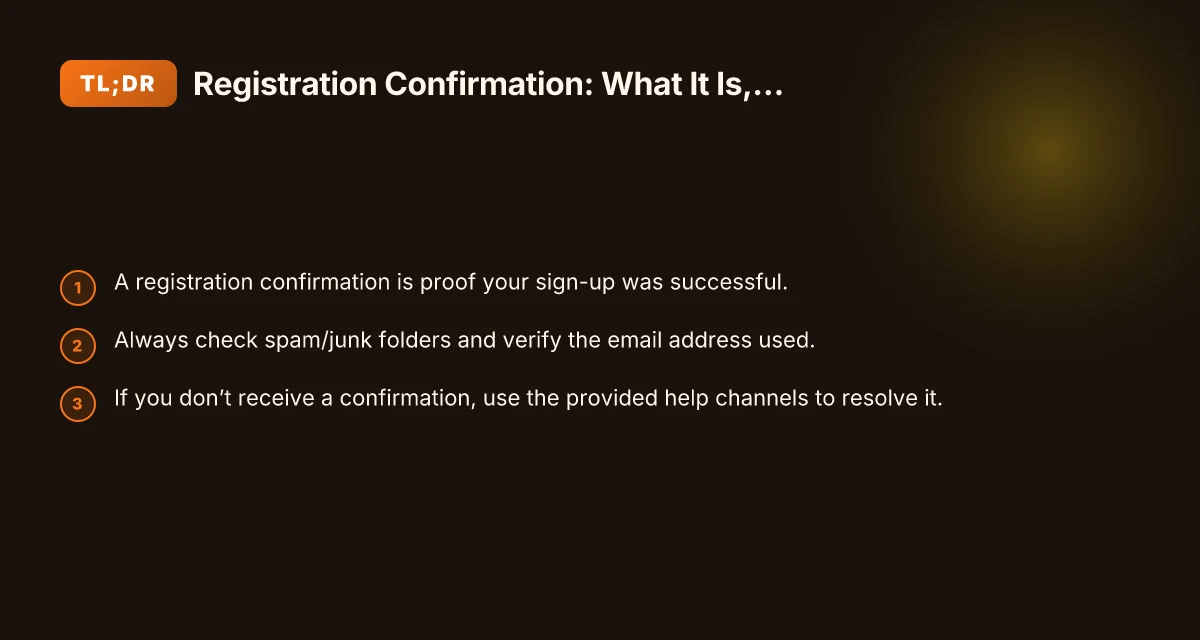
- Expect a confirmation as a sign that your registration is in the system. Treat it as a receipt and guide.
- If you don’t receive one, act quickly: re-check the form, verify the email, and reach out to support with your details.
- For organizers, prioritize speed, clarity, and accessibility in your confirmations to reduce confusion and support load.
- Keep a small personal system for tracking confirmations: a dedicated folder, a calendar reminder, and a backup copy of important confirmations.
Registration confirmations bridge the gap between signing up and taking action. By understanding what they are, how to respond to them, and what to do when they don’t arrive, you can navigate sign-ups with confidence and reduce the risk of missing deadlines or access. If you’d like, I can tailor this guide to a specific context, such as a conference, newsletter signup, or online service, and include ready-to-send templates.