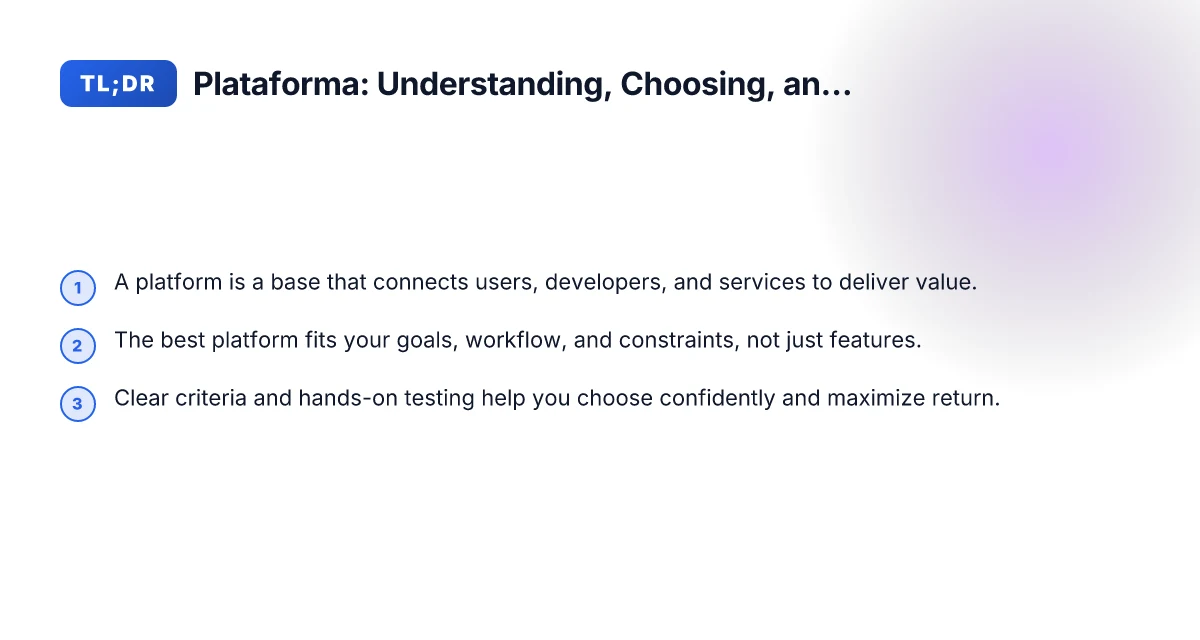
Plataforma: Understanding, Choosing, and Using the Right Platform for Your Needs
A practical guide to platforms, what they are, how they differ, and how to pick and use the right one.
Platforms sit at the center of modern digital ecosystems. Whether you’re building software, delivering content, or managing a business process, a platform can be the backbone that connects people, tools, data, and workflows. But “platform” is a broad term, and it means different things in different contexts. This guide breaks down what a platform is, how it differs from related concepts, how to evaluate options, and how to use a platform effectively.
Quick-compare dimensions for platforms and products
| Dimension | Platform | Product | Marketplace | Notes |
|---|---|---|---|---|
| Core purpose | Enables multiple apps/services | One app or suite | Hub for buyers/sellers | - |
| Typical user | Builders, integrators | End users, operators | Vendors, buyers | - |
| Extensibility | High (APIs, plugins) | Moderate (optional add-ons) | Varies (settlements, listings) | - |
| Governance model | Centralized/community | Proprietary | Marketplace rules | - |
| Data ownership | Shared/tenant data | Owner data | Transaction data | - |
Compiled November 2026; check the provider's site for current details.
What is a platform, and why does it matter?
A platform is more than a product or a service. It’s an integrated environment that enables multiple participants to interact with shared standards, interfaces, and resources. Key characteristics include:
- An ecosystem: a network of users, developers, partners, and data that adds value as it grows.
- Open or semi-open interfaces: APIs, SDKs, webhooks, or other mechanisms that let external developers build on or integrate with the platform.
- Core services: authentication, data storage, messaging, payments, analytics, or other services that support applications and workflows.
- Governance and rules: policies, pricing, and quality expectations that keep the platform healthy.
Why it matters: the right platform can accelerate innovation, reduce friction, and scale a solution far beyond what a standalone product could achieve. A well-chosen platform acts like a shared stage where many players can perform, create, and collaborate efficiently.
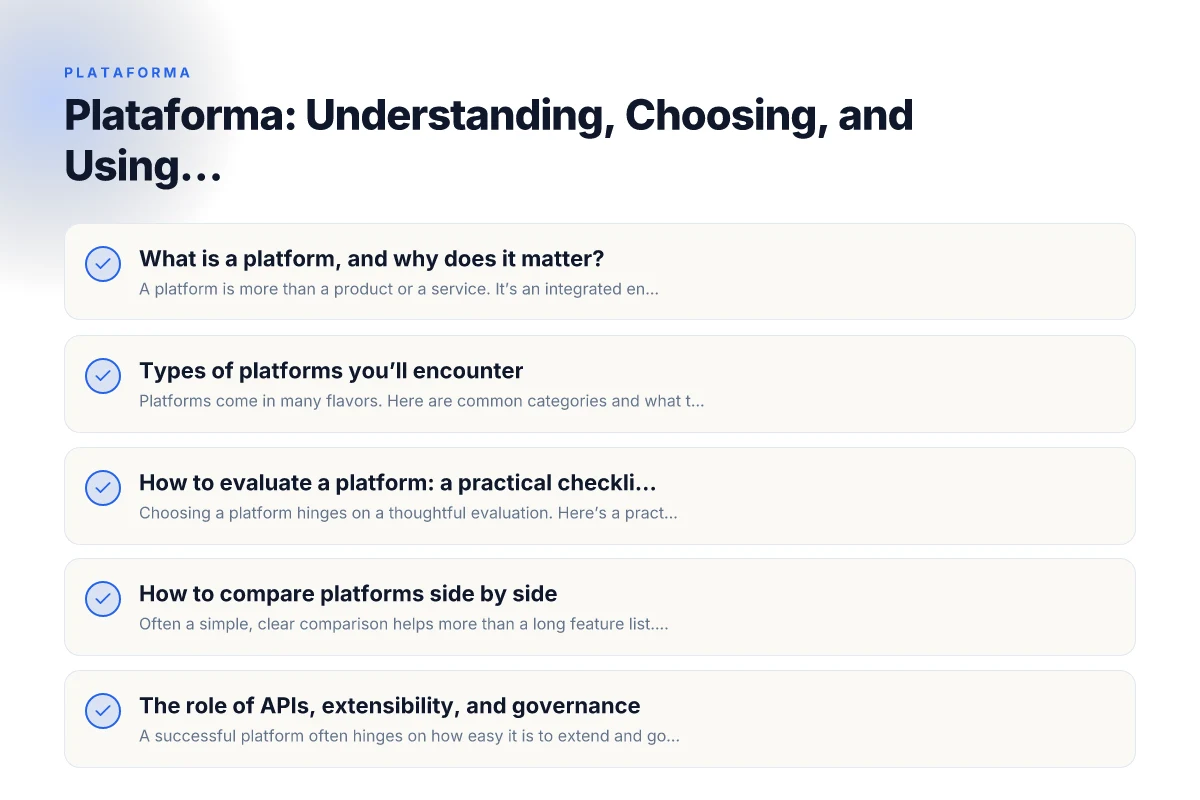
Types of platforms you’ll encounter
Platforms come in many flavors. Here are common categories and what they’re typically used for:
- Platform-as-a-Service (PaaS): A cloud-based environment where developers build and deploy applications without managing underlying infrastructure. Examples include Heroku, Google App Engine, and AWS Elastic Beanstalk.
- Software Platform: A base with built-in capabilities (auth, data, messaging) that enables developers to create applications on top of it. Examples include Salesforce, Microsoft Power Platform, and Shopify.
- Content Platform: A system for creating, managing, and delivering content to audiences. Examples include WordPress, Contentful, and Drupal.
- Developer Platform: An ecosystem that invites third-party developers to contribute apps, plugins, and integrations. Examples include Apple’s iOS, Android, and Salesforce AppExchange.
- Data Platform: A foundation for collecting, storing, processing, and analyzing data, often with governance and compliance features. Examples include Snowflake, Databricks, and Google BigQuery.
- Collaboration Platform: Tools and environments that enable teams to work together, share files, and manage workflows. Examples include Microsoft 365, Notion, and Slack.
How to evaluate a platform: a practical checklist
Choosing a platform hinges on a thoughtful evaluation. Here’s a practical checklist you can use: Intercambios: A Practical Guide to Exchanges and How to Use Them
- Define the problem: What are you trying to achieve? A platform should solve a real constraint or unlock a new capability.
- Fit with your stack: How well does the platform integrate with your current technology, language, and tools?
- Ecosystem and reach: Are there active developers, partners, or communities? Is there a marketplace of plugins or extensions?
- Governance and control: Can you manage security, compliance, and data ownership to your standards?
- Cost and total ownership: Consider not only up-front pricing but maintenance, scaling, and potential vendor lock-in.
- Performance and reliability: Look for SLAs, uptime history, data residency options, and disaster recovery plans.
- Usability and developer experience: How easy is it to get started, iterate, and ship features? Are there good docs, samples, and support?
- Security and compliance: Does the platform offer encryption, access controls, audit trails, and certifications relevant to your industry?
- Roadmap and support: Is there a clear product roadmap, regular updates, and responsive support?
Practical checklist for evaluating a platform (yes/no)
| Criterion | Required for decision | Platform | Product | Marketplace | Notes |
|---|---|---|---|---|---|
| API availability | Yes | yes | yes | yes | - |
| Documentation quality | Yes | good | adequate | varies | - |
| Security certifications | Yes | yes | sometimes | yes | - |
| Scalability | Yes | strong | moderate | strong | - |
| Governance clarity | Yes | clear | Limited | clear | - |
| Cost model transparency | Yes | transparent | opaque | transparent | - |
Compiled November 2026; check the provider's site for current details.
How to compare platforms side by side
Often a simple, clear comparison helps more than a long feature list. Consider this four-factor table when you’re evaluating two or more platforms.
| Factor | Platform A | Platform B |
|---|---|---|
| Core use case | What business problem it solves | What business problem it solves |
| Ecosystem readiness | Number of partners, plugins, APIs | Number of partners, plugins, APIs |
| Total cost of ownership | Licensing, usage, ops, support | Licensing, usage, ops, support |
| Security/compliance | Certifications, data controls, audits | Certifications, data controls, audits |
- If two platforms tie on features, lean toward the one with stronger ecosystem and lower total cost of ownership.
- If one platform dominates on security and compliance for your sector (healthcare, finance, etc.), that can be a decisive advantage even if it’s marginally more expensive.
- Always test a live scenario: prototype a small integration or workflow to validate performance and developer experience.
The role of APIs, extensibility, and governance
A successful platform often hinges on how easy it is to extend and govern: Fotos: what they are, how to take better ones, and where to store them
- APIs and SDKs: Robust, well-documented APIs and software development kits enable you to connect custom components, automation, and data flows. Look for versioning, rate limits, and reliability guarantees.
- Webhooks and event streams: Real-time data movement and responsive integrations are crucial for dynamic systems. Check the push model’s reliability and retry behavior.
- Extensibility model: Plugins, apps, or modules should be easy to add without breaking existing capabilities. Consider remoting or sandboxing safety in shared environments.
- Governance: Clear policies for who can publish on the platform, what data can be shared, and how access is controlled. Governance helps keep the ecosystem healthy and secure.
How to implement a platform in your organization
Adopting a platform is more than a technical decision, it’s an organizational one. Here are steps to maximize success:
- Align stakeholders: Bring product, security, operations, and business owners into a shared decision. Define success metrics together.
- Start small: Pick a high-impact, low-risk use case to pilot. Measure outcomes, iterate, and scale.
- Establish governance: Create roles (owners, approvers), data policies, and security baselines before mass adoption.
- Invest in skills: Provide training for developers and operators. A strong internal team reduces reliance on external consultants.
- Plan for migration: If you’re moving from a legacy system, map data, workflows, and integrations carefully to minimize disruption.
- Monitor and evolve: Track performance, costs, and user satisfaction. Use the platform’s roadmap to anticipate changes you’ll need.
Side-by-side feature matrix (6 features)
| Feature | Platform | Product | Marketplace | Notes |
|---|---|---|---|---|
| Extensibility | High | Medium | Medium | - |
| API access | Yes | Yes | Often | - |
| Custom apps | Yes | No | No | - |
| Multi-tenant data | Yes | Yes | Yes | - |
| Compliance support | Yes | Some | Varies | - |
| Vendor ecosystem | Large | Small | Large | - |
Compiled November 2026; check the provider's site for current details.
A practical comparison: platform vs. product vs. marketplace
When you’re deciding whether to invest in a platform, it helps to differentiate from related concepts. Here’s a quick guide: Formacion de profesores fpele
- Platform vs product: A platform enables a broader ecosystem and longer-term adaptability, while a product tends to be a standalone solution with fixed scope.
- Platform vs marketplace: A platform often provides programmatic access and core services. A marketplace primarily connects buyers and sellers and may rely on platform features to enable transactions.
Simple distinctions:
- Platform: Core services, extensibility, governance, ecosystem growth.
- Product: Focused value proposition, limited customization, direct customer relationship.
- Marketplace: Central venue for third-party goods or services, with a distribution model.
Real-world examples and what you can learn from them
- Salesforce: A platform with a large ecosystem of apps and integrations. Lesson: The value of a mature marketplace and developer community can accelerate adoption and scale.
- WordPress: An open-content platform with vast plugin options. Lesson: Extensibility and accessibility drive widespread use and long-term resilience.
- Snowflake: A data platform focusing on governance, performance, and cross-cloud availability. Lesson: Strong data governance and multi-cloud strategy are powerful differentiators in data-centric workloads.
- Shopify: An e-commerce platform that enables not just storefronts but apps and integrations. Lesson: A platform that serves both merchants and developers creates a thriving ecosystem.
Real-world decision guide (4 scenarios)
| Scenario | Best fit | Alternatives | Key trade-offs | What to verify |
|---|---|---|---|---|
| You need to build integrations | Platform | Product | Extensibility vs focus | API rate limits, governance |
| You want a standalone tool | Product | Platform | Usability vs flexibility | Adoption, support |
| You need a marketplace | Marketplace | Platform | Ecosystem vs control | Listing rules, fees |
| You want to innovate internally | Platform | Product | Custom dev potential | Devops, security posture |
Compiled November 2026; check the provider's site for current details.
Common pitfalls to avoid
- Overestimating the platform’s “lock-in” benefits: Heavy dependence on a single platform can become a risk if pricing or policy changes are misaligned with your business.
- Underinvesting in migration planning: Rushing to a platform without a clear migration path can cause data integrity issues and downtime.
- Ignoring governance: Without proper controls, an expanding ecosystem can lead to security gaps and compliance problems.
- Failing to measure ROI: Platforms require ongoing investment. Track metrics like time-to-delivery, feature velocity, and total cost of ownership.
Final recommendations
- Start with your goal: Before evaluating, articulate the problem you want the platform to solve and the outcomes you expect.
- Prioritize ecosystem and extensibility: A healthy ecosystem accelerates innovation and expands capabilities beyond your internal band.
- Test with a real use case: Build a small pilot that mirrors actual workflows, not just a lab exercise. Measure results against your success criteria.
- Consider long-term flexibility: Choose a platform that can scale with your needs, supports important data governance, and minimizes vendor risk.
- Invest in governance and skills: The platform is only as good as the people and policies that operate it. Ensure clear ownership, training, and security standards.
If you’re evaluating a platform for a business, a project, or a developer ecosystem, this framework can help you decide with clarity and confidence. The right platform should feel like a natural extension of your goals: more speed, more control, and more opportunity to create value. Examenes oficiales: what they are, how to prepare, and where to find them