Boletin: what it is, uses, and how to create effective boletines
A practical guide to boletin, its purposes, and best practices for craft and distribution.
Boletin is a term steeped in communication practice. In many contexts, it refers to a brief, regular update sent to a specific audience. Think of a boletin as a lightweight version of a newsletter: short, focused, and timely. The word appears in Spanish and Portuguese contexts. The concept translates to many languages and industries. Whether you call it a boletin, newsletter, or update, the core idea is the same: deliver relevant information in a digestible format on a predictable schedule.
Comparison of boletin formats and styles
| Format/Style | Email boletin | Web-based boletin | Printable/PDF boletin | Interactive/interactive elements | Mobile-friendly | Typical use cases |
|---|---|---|---|---|---|---|
| Primary channel | Email inbox | Website or portal | Print-ready document | Embedded widgets or micro-interactions | Yes | Announcements, newsletters, lead magnets, archives |
| Visual density | Low to medium | Medium to high | Low | High | High | Compact, skimmable vs. rich content |
| Accessibility aids | Alt text; readable fonts | Keyboard nav; skip links | High-contrast; print-friendly | Accessible controls | Responsive | Various reader needs |
| Tracking/metrics | Opens, clicks | Page views, time on page | Distribution count | Interactive analytics | Mobile metrics | Performance insights |
| Distribution | Send via ESP | Publish URL | Print distribution | Embedded in site or app | Consumed on mobile | Reach and reuse |
| Ideal length | Short to medium | Medium to long | Varies; printer-friendly | Medium; interactive sections | Short to medium | Engagement strategy |
Compiled November 2026; check the provider's site for current details.
What a boletin is and isn’t
What it is
- A recurring communication: usually weekly, biweekly, or monthly.
- A focused message: one theme or a small set of related topics.
- A value-providing resource: offers summaries, insights, or actionable steps.
- A tool for engagement: includes calls to action, feedback prompts, or links to resources.
What it isn’t
- A long-form report: boletins are compact and skimmable.
- A one-off announcement: consistency matters for reader trust.
- A sales pitch without value: readers expect practical information or insights.
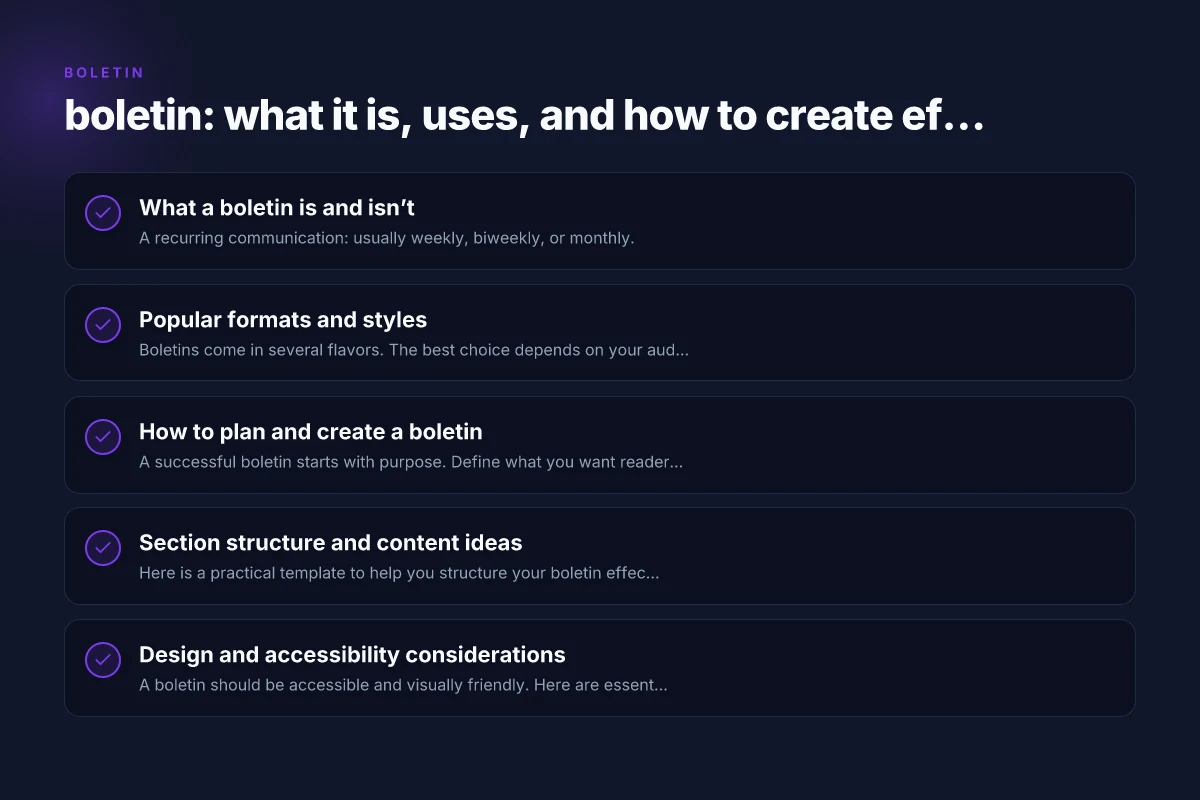
Popular formats and styles
Boletins come in several flavors. The best choice depends on your audience and goals. Here are common formats:
- News roundup: a quick summary of relevant happenings, with links to deeper reads.
- Insight brief: one or two expert perspectives, plus practical takeaways.
- Product or service update: highlights of new features, timelines, or tips.
- Resource digest: curated links, tools, templates, or how-tos.
- Event notice: dates, registration, and what attendees will gain.
Style tips for readability
- Use a clear subject line or title that sets expectations.
- Keep paragraphs short. Use bullet points for scannability.
- Include a short intro that frames the issue or theme.
- Finish with a clear call to action or next steps.
How to plan and create a boletin
A successful boletin starts with purpose. Define what you want readers to do after reading. Then align your content, cadence, and distribution around that purpose.
Step-by-step planning
- Define audience and goals: who is this for, and what should they do?
- Choose cadence: weekly, biweekly, or monthly? Consistency beats volume.
- Decide content mix: news, insights, and practical tips.
- Create a content calendar: map topics to issues.
- Gather content sources: internal notes, analytics, customer feedback, expert contributors.
- Draft a template: header, body with sections, and footer with CTAs.
- Review and test: check readability, links, and accessibility.
- Send and measure: track opens, clicks, and conversions.
Content ideas you can reuse
- A brief market or industry update.
- A spotlight on a team member or customer story.
- A “how-to” tip or quick guide.
- A resource recommendation (tool, template, or article).
- A question or poll to boost engagement.
Section structure and content ideas
Here is a practical template to help you structure your boletin effectively. Use it as a starting point and tailor it to your audience.
- Subject line: 8-12 words that convey the main value.
- Opening line: one crisp sentence that sets the tone.
- Main section: 3–5 bullet points or a short narrative with 2–3 subheadings.
- Spotlight or tip: a focused piece (customer story, feature highlight, or how-to).
- Resources: 2–4 links to tools, guides, or reports.
- Poll or question: invites reader interaction.
- Closing and CTA: a clear next step (register, read, or reply).
Optional sections
- Quick analytics snapshot: one line with key KPI insight.
- Upcoming events: dates and how to join.
- FAQ or tips: answers to common questions.
Design and accessibility considerations
A boletin should be accessible and visually friendly. Here are essential tips: Acerca de nosotros
- Font and contrast: use readable fonts and high contrast for readability.
- White space: give content room to breathe. Avoid crammed layouts.
- Mobile-friendly: many readers view on phones. Use responsive design if possible.
- Alt text for images: always provide descriptive alt text.
- Clear CTAs: buttons or links with action-oriented text.
- Plain language: write for clarity. Avoid jargon or explain it.
A simple comparison: boletin vs. traditional newsletter
| Attribute | Boletin | Traditional Newsletter |
|---|---|---|
| Tonality | Concise, goal-driven | Varied, may be longer-form |
| Frequency | Regular (weekly/biweekly/monthly) | Often monthly or irregular |
| Content scope | Narrow focus, high relevance | Broader topics, multiple sections |
| Reader effort | Low effort, skimmable | Higher effort, more reading required |
| CTA emphasis | Immediate action or next steps | Can be informational with softer CTAs |
This table helps illustrate how boletin style prioritizes brevity and action, while a traditional newsletter may explore themes more broadly and in depth.
Measuring success and iterating
To improve your boletin over time, track both engagement and outcomes. Useful metrics include:
- Open rate: indicates subject line relevance and sender trust.
- Click-through rate (CTR): shows interest in linked content.
- Completion rate: for newsletters with longer sections.
- Reply rate: direct engagement and qualitative feedback.
- Conversion metrics: sign-ups, registrations, or purchases tied to CTAs.
- Feedback sentiment: reader comments, surveys, or polls.
Use these insights to adjust content mix, cadence, and formats. For example, if CTR is high on tips, you might add a dedicated “Tips” section in every issue.
Comparison of design and accessibility considerations How to use the phrase "nous contacter" to reach French-speaking support and the best ways to contact
| Consideration | Text readability | Color and contrast | Typography | Images and media | Navigation and structure | Accessibility standards |
|---|---|---|---|---|---|---|
| Guidelines | Sans-serif; 14–18px | Sufficient contrast | 1–2 max font families | Alt text; captions | Clear headings | WCAG 2.1 AA compliant |
| Common pitfalls | Tiny fonts; dense blocks | Low contrast; unreadable | Over-stylized | Missing alt text; auto-play | Deep nesting; clutter | Missing aria labels |
| Recommendations | Use generous line height | Ensure 4.5:1+ contrast | Use hierarchy; scale | Describe media; avoid auto-play | Logical tab order | Test with assistive tech |
| Benefits | Readability; comfort | Visibility; inclusivity | Brand readability | Engagement with media | Fast scanning | Wider accessibility |
| Tools | Accessibility checkers | Color contrast analyzers | Font pairing guides | Captioning services | Sitemap and nav tests | Screen reader testing |
Compiled November 2026; check the provider's site for current details.
Best practices and common pitfalls
- Be consistent with timing and format. Readers rely on routine.
- Begin with value: your first line should answer “what’s in it for me?”
- Keep the length reasonable: aim for a digestible length that respects readers’ time.
- Avoid overwhelming with calls to action. One clear primary ask per issue.
- Personalize where feasible: segment audiences and tailor content.
- Proofread and test links before sending.
- Respect privacy and consent: manage subscriptions ethically.
Common pitfalls to avoid:
- Sponsor-heavy content that dilutes value.
- Inconsistent branding or tone across issues.
- Long walls of text without scannable subheads.
- Missing or broken links.
- Overlooking readability on mobile devices.
Getting started with your first boletin
If you’re new to boletins, here is a practical checklist to launch quickly:
- Define your audience and objective in one sentence.
- Decide cadence and commit to a trial period (e.g., 3 months).
- Create a lightweight template with 3 core sections: Update, Spotlight, Resources.
- Gather a small set of core topics for the first issue.
- Draft, review, and send a soft launch to a test group.
- Collect feedback and adjust content and design.
If you’re managing multiple boletins (for different teams or segments), consider a modular approach: reusable blocks that you can assemble in each issue, reducing workload and ensuring consistency. Servicios: understanding what they are and how to choose the right ones for you
Comparison of boletin planning and creation workflows
| Stage | Purpose | Key deliverables | Responsible roles | Timeframe | Success signals |
|---|---|---|---|---|---|
| Define goals | Align with audience needs | Objectives; KPI targets | Editor; Marketing lead | 1–2 days | Clear goals documented |
| Audience mapping | Segment targeting | Personas; reader journeys | Content strategist | 2–3 days | Segmented plan ready |
| Content plan | Topic + format decisions | Editorial calendar | Editor; Writers | 1–2 weeks | Calendar filled; assign |
| Template selection | Layout consistency | Template variants | Designer | 3–5 days | Approved templates |
| Production | Create content assets | Draft boletin; assets | Writers; Designer | 1–2 weeks | Draft ready for review |
| Review & compliance | Quality; accessibility | Checks; edits | Editor; Compliance | 3–5 days | Final copy approved |
| Launch prep | Distribution setup | Send schedule; versions | MarketingOps | 1 day | Schedule set |
| Post-launch review | Learn and iterate | Metrics report; notes | Editor | 1 week after | Learnings documented |
Compiled November 2026; check the provider's site for current details.
Final recommendation
A boletin can become a powerful connective tissue between your organization and its audience when it blends relevance, brevity, and consistency. Start with a clear purpose, design for skimmability, and lean into a predictable cadence. Prioritize reader value, and experiment with formats and topics to see what resonates. With time, your boletin can become an expected, trusted resource that informs, guides, and engages your audience on an ongoing basis.